10
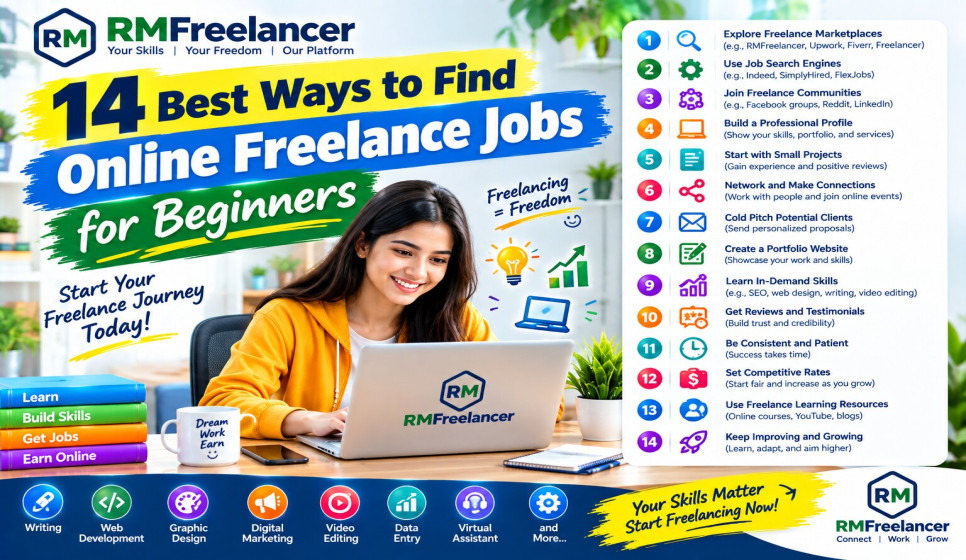
Sep14 Best Ways to Find Online Freelance Jobs for Beginners
Guide to Finding Your First Freelance Opportunities Online
Starting a freelance career online can offer flexible work hours, the chance to earn money on your own, and great learning experiences. But for new freelancers, the main challenge is finding real job opportunities to begin with. Without reviews from past clients, a strong portfolio, or a long list of previous projects, it's hard to know where to start.
The good news is that beginners don't need to wait until they're experts to start looking for freelance work. By focusing on one specific skill, presenting yourself in a professional way, and using smart job search methods, you can find opportunities even when you're just starting out.
Freelance work is available in many different fields.
Some common areas include writing, designing graphics, improving websites with search engines, building websites, managing social media, offering virtual help, translating languages, editing videos, providing customer support, and promoting online businesses. The important thing is to find a skill you can do reliably and then find people who need that skill.
This guide gives 14 useful tips for new freelancers to find online jobs, build trust, and gradually grow a steady freelance career.
1.
Identify a Marketable Skill
The first step in securing freelance work is to recognize precisely what you can offer. New freelancers often create broad profiles claiming expertise in various unrelated fields, making it hard for potential clients to identify their true specialty.
Select one primary skill and refine it. This could be article writing, SEO support, logo design, WordPress assistance, social media management, data entry, or video editing.
A clearly defined specialty streamlines your job search by allowing you to focus on projects that align with your abilities. It also aids in creating more relevant portfolio samples and crafting targeted applications.
Your initial specialty doesn’t have to be permanent; it can evolve as your skills and experience grow.
2.
Create Portfolio Samples Before Securing Clients
Having no prior customers shouldn’t hold you back from assembling a portfolio. Instead, develop demonstration projects that showcase your potential capabilities.
For instance, a beginner writer could craft original blog posts, while a designer might create fictional branding materials. An SEO novice could prepare a sample website audit, and a developer might build a basic demo site.
Clearly label personal or practice projects to ensure transparency. Their purpose is to showcase your skills rather than misrepresent them as paid work.
A small selection of well-executed samples can provide prospective clients with something tangible to assess.
3.
Build a Professional Online Profile
Your profile is typically the first impression a potential client has of you. Ensure it is clear, concise, and focused on the services you offer.
Include a professional introduction that outlines your specialty and the problems you can solve. When appropriate, add relevant skills, portfolio examples, education, certifications, or personal projects.
Refrain from making exaggerated claims. A beginner who accurately represents their abilities can build more trust than someone who boasts unrealistic expertise.
Your profile should answer the following questions: What can you do? Who can you help? Why should someone choose to collaborate with you?
4.
Explore Freelance Marketplaces
Freelance marketplaces can give beginners a convenient way to find projects posted by clients looking for specific services.
Create comprehensive profiles and browse projects that match your current skills. Pay close attention to job requirements, deadlines, budgets, and expected deliverables before submitting an application.
Avoid applying to every listing simply to inflate the number of applications. Focusing on a smaller number of well-thought-out opportunities can be more effective than submitting many unrelated applications.
As you complete jobs, your portfolio, feedback score, and professional reputation can strengthen.
5.
Search for Entry-Level Assignments
Beginners should intentionally seek projects that align with their current experience level. Look for terms such as entry-level, beginner-friendly, junior, simple project, short-term, or small task.
While these positions may not offer high pay, they provide something incredibly valuable: hands-on experience.
Taking on manageable projects equips you with essential skills for client communication, understanding instructions, managing deadlines, organizing files, handling revisions, and delivering completed work.
These experiences will be invaluable for applying to more advanced projects in the future.
6.
Write Personalized Proposals
Customizing every application is one of the most effective ways to enhance your chances of being noticed.
Before crafting a proposal, thoroughly read the client’s requirements. Identify the primary issue and describe how your service can address it.
Whenever possible, reference relevant experience or portfolio samples, steering clear of vague statements. Keep your message professional and easy to digest.
Instead of saying, “I am the best freelancer and can do your project flawlessly,” describe your actual approach and how it aligns with the client’s needs.
A thoughtful proposal reflects attention to detail and professionalism.
7.
Use Professional Networking
Freelance opportunities often arise from connections rather than conventional job postings. Networking enables beginners to engage with business owners, entrepreneurs, agencies, marketers, developers, designers, and other professionals.
Establish a professional presence on relevant networking platforms and engage with individuals in your industry.
Share valuable insights, thoughtfully comment on discussions, and showcase selected works. Avoid sending unsolicited promotional messages to everyone you connect with.
Strong professional relationships can eventually yield referrals, collaborations, subcontracting opportunities, or direct assignments.
8.
Join Relevant Online Communities
Communities tailored to specific industries can be excellent venues for learning and uncovering potential opportunities.
Seek out groups related to your chosen field, such as writing, SEO, programming, design, marketing, or virtual assistance. Engage by responding to inquiries, sharing helpful resources, and offering practical ideas.
Refrain from using every community as a promotional outlet; excessive self-promotion can tarnish your reputation.
Instead, showcase your expertise organically. As members begin to recognize you as a helpful and trustworthy resource, professional opportunities may become more accessible.
9.
Contact Small Businesses Directly
Many small businesses need freelance support but may not post formal job openings.
Identify companies that could benefit from your specific services, and prepare a brief, personalized message explaining how you could assist.
For example, a local business may need writing or SEO help due to outdated website content, or a firm with inconsistent social media graphics might require design support.
Avoid sending generic mass messages. Highlight the specific opportunity you identified and suggest a practical solution.
Direct outreach is particularly advantageous for beginners as it allows you to present your services without competing against a large pool of applicants.
10.
Explore Remote Job Websites
Remote job websites often feature freelance contracts, temporary assignments, part-time roles, and project-based work.
Use targeted search phrases related to your skill set rather than relying solely on generic terms like “online jobs.”
A budding writer may search for terms like remote content writer, junior copywriter, or blog writing assistant. Someone interested in SEO might look for SEO assistant, SEO trainee, or link-building assistant.
Specific search terms help filter out irrelevant results and make it more manageable to find positions suitable for your current skills.
11.
Create Clearly Defined Service Packages
Beginners can simplify their services by developing clear packages.
Instead of stating, “I provide all digital marketing services,” outline a specific offering with concrete deliverables.
For instance, you could offer a basic website audit, several social media graphics, a set of product descriptions, or a designated number of virtual-assistance hours.
Clear packages reduce confusion as clients can easily understand what they are purchasing.
They can also enhance the professionalism and organization of your service, even as you build your career.
12.
Connect With Other Freelancers
Other freelancers can serve as significant sources of knowledge and opportunity.
Experienced professionals may have more work than they can manage and need reliable assistance. Fostering genuine relationships with freelancers in complementary fields can present opportunities for collaboration.
For example, a web developer might require a content writer, while a digital marketer could need graphic design support.
Do not approach every freelancer solely to request work. Establish useful professional relationships first. Share knowledge, communicate professionally, and prove you are reliable.
Over time, these connections can become an essential aspect of your freelance network.
13.
Ask Satisfied Clients for Recommendations
After successfully completing your initial projects, don’t underestimate the value of referrals.
If a client is genuinely pleased with your work, kindly inquire if they would recommend your services to anyone who may need similar assistance.
You can also ask for reviews or testimonials where permitted.
Positive feedback serves as social proof for future prospects. A new freelancer with several authentic reviews will appear considerably more trustworthy than someone with no evidence of past work.
Prioritize delivering exceptional service before requesting referrals.
14.
Maintain a Consistent Job-Search Routine
Freelance success rarely stems from sporadically searching for opportunities. Consistency is crucial.
Establish a weekly schedule incorporating project research, proposal writing, skill advancement, portfolio enhancement, networking, and client communication.
Track your applications and note which ones yield responses. Over time, this data can reveal which services, industries, project types, and proposal styles yield better outcomes.
Do not be disheartened by rejections. They can provide insights into whether your pricing, portfolio, proposal, or targeting needs refinement.
A consistent routine transforms job searching into a structured professional endeavor rather than a haphazard process.
How to Make Your First Freelance Job Successful
Getting hired is just the beginning. Your performance once you receive an assignment can determine whether you receive further work.
Before beginning, clearly understand the project requirements. Confirm the expected deliverables, deadlines, communication methods, and revision protocols.
During the assignment, keep organized and communicate as needed. If a potential issue arises that may affect the deadline, notify the client as early as possible instead of waiting until the last moment.
Before submitting the final work, conduct a thorough review. Correct spelling mistakes, formatting issues, missing information, and technical errors.
A reliable beginner can build a strong reputation much quicker than someone who focuses solely on obtaining new projects.
Common Mistakes Freelancers Should Avoid
New freelancers often make missteps that can impede their progress.
Applying to unsuitable projects:
Only pursue assignments that reasonably match your skills.
Copying proposals:
Generic applications fail to demonstrate genuine interest.
Making unrealistic promises:
Never guarantee results or deadlines you cannot confidently meet.
Using fabricated experience:
Honesty is vital when building a professional reputation.
Ignoring portfolio quality:
A few strong examples usually hold more weight than numerous weak ones.
Focusing only on price:
Extremely low rates can raise doubts about quality.
Neglecting communication:
Professional communication is integral to the service itself.
Avoiding these common pitfalls can help beginners lay a solid foundation from the outset.
Building a Sustainable Freelance Career
While the immediate goal is to find work, the broader objective should be establishing a viable career.
After completing several assignments, assess which services yield the best results and which types of clients you enjoy working with. Gradually refine your focus to areas where your skills and market demand intersect.
Continue to learn new tools and techniques. Regularly update your portfolio, replacing weaker examples with stronger projects.
As you gain expertise, reputation, and skills, consider increasing your rates. Rather than striving for rapid growth, aim for steady advancements.
A thriving freelance career typically develops through continual improvements rather than one significant breakthrough.
Frequently Asked Questions (FAQs)
What is the easiest way for beginners to find online freelance jobs?
ANSWER:
Beginners can start by picking one useful skill, making sample work to show their abilities, joining the right websites where freelancers post jobs, and applying for small projects that match what they can do right now.
Can I get freelance work without having professional experience?
ANSWER:
Yes. You can show what you can do through your own projects, practice work, certificates, and a good portfolio instead of only relying on past jobs.
Which freelance jobs are suitable for someone just starting?
ANSWER:
Jobs like writing content, helping with virtual tasks, designing graphics, improving website rankings, managing social media, translating text, entering data, doing basic web development, and editing videos may be good options depending on what skills you already have.
How can I create a portfolio when I have never had a client?
ANSWER:
Make your own sample projects that show the kind of work you want to offer. Create realistic examples and clearly mark them as personal or demo work.
How should beginners approach potential freelance clients?
ANSWER:
Carefully read the job description, figure out what the customer really needs, and send a short message explaining how your skills can help them. If possible, include a relevant sample of your work.
Should new freelancers accept every available project?
ANSWER:
No. Choose projects that fit your skills, time, and interests. Taking work that doesn’t match your strengths can cause missed deadlines, bad results, and unhappy clients.
How can a beginner make a freelance profile more convincing?
ANSWER:
Use a strong headline, clearly explain your services, list your skills, show quality samples, provide correct information, and use professional language. Your profile should quickly show what value you can bring.
Is networking useful for finding freelance opportunities?
ANSWER:
Yes. Building connections with business owners, agencies, professionals, and other freelancers can lead to referrals, teamwork, subcontracting, and even direct clients.
What should I do if my freelance applications receive no responses?
ANSWER:
Check your targeting, portfolio, how you write your proposals, your pricing, and how your profile looks. Apply to more relevant projects and tailor each message instead of sending the same one again and again.
How can beginners turn their first freelance project into repeat work?
ANSWER:
Do the work carefully, meet deadlines, communicate politely, and respond well to feedback. Happy clients may come back with more work or recommend you to others.
Final Summary,
Finding online freelance jobs as a beginner is entirely achievable with a structured approach. You don’t need an impressive employment history to start. What you require is a valuable skill, credible examples, professional communication, and the determination to persist in your search and learning.
The 14 strategies outlined here provide various pathways to securing your first opportunity, from freelance marketplaces and remote job boards to networking, direct outreach, online communities, and referrals.
Begin with projects that align with your current abilities. Deliver every task responsibly, learn from feedback, and enhance your portfolio following each experience. With consistent effort and an authentic professional attitude, small freelance endeavors can gradually lead to repeat business, greater expertise, and a fulfilling long-term online career.
Need assistance with our services? Contact our experienced support team for prompt and friendly customer care.
Website: https://rmfreelancer.com/
Email: support@rmfreelancer.com
Phone: +1 307-243-8976
RMFreelancer Office:
30 N Gould St, Ste R, Sheridan, WY 82801, USA


