10
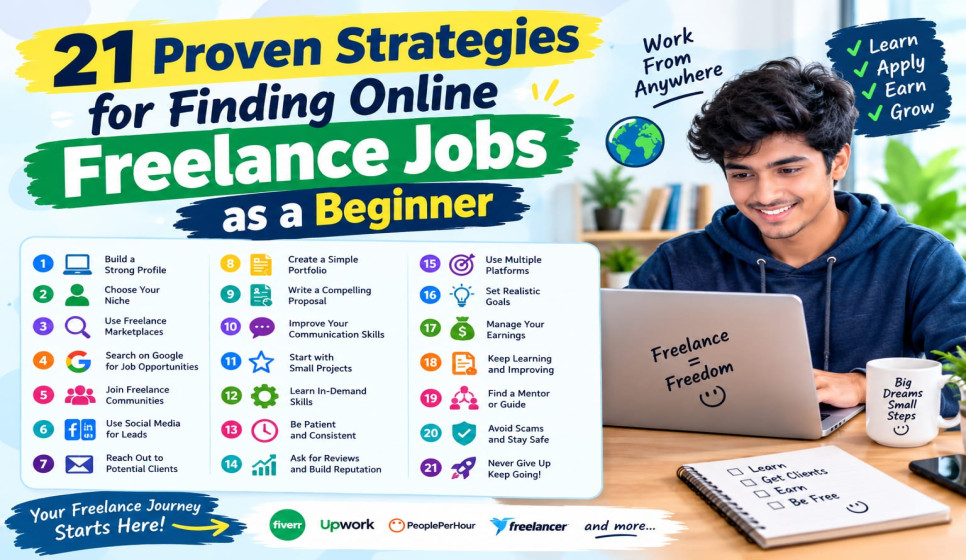
Sep21 Proven Strategies for Finding Online Freelance Jobs as a Beginner
Starting a freelance career can be a great way to turn useful skills into money while having more freedom in where and when you work. But for new people, it can be tough to get real projects without having a history with clients.
The good news is you don't need a long list of past projects to begin. By choosing a skill you're good at, making a strong portfolio, talking to clients in a professional way, and using a smart plan to find work, you can find opportunities even if you're new.
Freelance jobs are available in many areas like writing, search engine optimization, graphic design, coding, video editing, translating, virtual help, managing social media, research, and online marketing. The challenge is not just finding any job, but finding ones that match your skills, connecting with the right people, and building enough trust to get hired.
Here are 21 helpful tips to help new freelancers find their first online projects.
1.
Choose One Key Skill
Start by identifying one service you can deliver with confidence. A focused specialization clarifies your professional identity and streamlines your job search.
Instead of presenting yourself as a jack-of-all-trades, concentrate on a niche like article writing, SEO support, graphic design, WordPress assistance, social media management, or virtual assistance.
You can expand your offerings later. Initially, focusing allows for more efficient practice and the creation of stronger work examples.
2.
Investigate Current Market Demand
Before dedicating significant time to a specific service, research what businesses are currently seeking.
Examine freelance listings, company websites, professional networks, and service marketplaces to pinpoint in-demand skills. Look for frequent requests and common issues that companies want freelancers to address.
This exploration enables you to select a specialization with genuine market demand rather than solely relying on personal assumptions.
3.
Develop Original Portfolio Pieces
A newcomer without previous clients can still showcase their competence through self-created work.
Craft realistic examples relevant to your chosen specialty. For instance, a writer could create sample articles, while a designer might develop fictional branding projects. An SEO enthusiast could prepare a mock website analysis.
Ensure your examples are original and polished. Never present practice work as if it were derived from a paying client.
4.
Create a Targeted Professional Profile
Your profile should instantly convey to prospective clients what you do.
Write a clear introduction outlining your specialty, relevant skills, and the type of assistance you offer. Include selected portfolio samples and pertinent qualifications.
Avoid unnecessary personal details and exaggerations. A straightforward, honest profile enhances your professional image.
5.
Explore Various Freelance Platforms
Relying on a single website can limit your opportunities. Investigate multiple reputable freelance platforms tailored to your specific field.
Each platform has unique clients, varying competition levels, project categories, and application processes. Analyze them carefully and concentrate on those where your services are genuinely sought.
Quality is more important than creating numerous inactive profiles.
6.
Target Entry-Level Projects
Specifically search for assignments suitable for beginners. Utilizing keywords such as junior, entry-level, basic task, short project, and assistant can reveal more accessible opportunities.
While small projects may not offer substantial initial income, they can provide insight into how professional client work operates.
Leverage early assignments for practical experience instead of judging all opportunities solely based on their starting payment.
7.
Tailor Every Proposal
A customized proposal can set you apart from applicants who send identical messages.
Carefully read the project description to grasp the client's primary goal. Briefly explain how your skills relate to that need.
Reference a relevant portfolio sample when feasible. Keep your writing natural, specific, and professional.
The aim is to demonstrate your understanding of the assignment—not simply to announce your availability.
8.
Show Understanding Before Discussing Price
Many beginners start by competing on price; however, a more effective strategy is to first demonstrate your comprehension of the client's needs.
Outline what you would deliver and your approach to the assignment. When the client sees the value of your contribution, pricing becomes just one factor in their decision.
While competitive pricing can be beneficial, it should not be your sole selling point.
9.
Establish a Professional Networking Presence
Networking can reveal opportunities that aren't listed on freelance websites.
Create profiles on suitable professional networks and clearly articulate your specialty. Connect with entrepreneurs, agencies, startups, marketers, and other professionals who may require your services.
Occasionally share insights and engage thoughtfully with others' posts. Genuine networking is often more effective than constant self-promotion.
10.
Engage in Specialized Communities
Online communities related to your field can provide both knowledge and potential contacts.
Join relevant groups where discussions about your expertise occur. Answer questions, share practical tips, and contribute useful resources.
Avoid overwhelming communities with advertisements. Building credibility through helpful participation can make people more willing to reach out to you for assistance later.
11.
Contact Small Businesses Directly
Small companies often require specialized assistance but may not post formal freelance job listings.
Identify businesses whose websites, content, marketing materials, graphics, or online presence may benefit from your services. Then, draft a brief, personalized introduction.
Your outreach should specify a particular improvement you could offer. Steer clear of generic messages sent to numerous businesses.
A thoughtful approach reflects initiative and awareness of business needs.
12.
Explore Remote Contract Positions
Remote job boards can feature temporary roles, project contracts, part-time jobs, and freelance positions.
Search using terms directly tied to your specific skill. For instance, someone interested in writing might seek content assistant roles, while an SEO novice could look for junior optimization roles.
Carefully read the qualifications required. Selectively applying helps you focus on submitting stronger applications.
13.
Create Clear, Simple Offers
New freelancers can make their services easier to buy by designing straightforward packages.
Rather than offering a vast array of work, clearly define the task, quantity, deliverables, and estimated completion time.
For example, a new designer might offer a small set of social graphics, while a writer could provide several product descriptions. A virtual assistant might propose a specific number of support hours.
Defined offers reduce uncertainty for first-time clients.
14.
Foster Relationships With Other Freelancers
Networking shouldn't solely focus on potential clients. Other freelancers can become valuable professional contacts.
Someone with strong development skills might need a designer. A marketing expert could require a writer. An experienced freelancer may sometimes need assistance managing a heavy workload.
Build relationships naturally, and demonstrate reliability. Collaborative connections may ultimately lead to referrals or subcontracting opportunities.
15.
Utilize Referrals to Broaden Your Reach
After successfully completing a project, ask satisfied clients if they know anyone who could benefit from your services.
Referrals can be especially powerful, as a recommendation from a current client can establish initial trust.
Always make requests politely and avoid pressuring clients. Delivering exceptional work should precede the request for additional opportunities.
16.
Gather Genuine Testimonials
Positive feedback can enhance your professional reputation.
When a client is genuinely satisfied with your work, ask if they would be willing to provide a brief testimonial or review where appropriate.
Include authentic feedback in your portfolio or professional profile. Never fabricate reviews or make misleading claims about your experience.
Genuine testimonials can reassure potential clients considering hiring someone new.
17.
Enhance Your Communication Skills
Technical expertise is only one aspect of successful freelancing. Clients also appreciate freelancers who communicate clearly.
Respond professionally, understand instructions, ask relevant questions when necessary, and provide updates when appropriate.
Avoid overly complex messages. Convey important information in a straightforward manner.
Effective communication can enhance a beginner's image as reliable and easy to work with.
18.
Monitor Your Applications
Keep a record of each serious application you submit.
Note the project type, client category, application date, proposed price, response, and outcome. Reviewing this data can reveal useful trends.
For example, you might find that writing projects garner more responses than marketing assignments, or that tailored proposals perform better than generic messages.
Use these insights to refine your strategy rather than repeating ineffective methods.
19.
Continue Learning While Job Searching
Don’t devote all your time to job applications. Set aside some of your schedule for honing your skills.
Study current techniques, practice relevant tools, analyze professional examples, and work on educational projects.
Ongoing learning strengthens your portfolio and prepares you for more challenging assignments.
The goal is to develop your skills while actively searching so that your capabilities grow even if applications don’t yield immediate results.
20.
Protect Your Professional Reputation
Your reputation starts with your first project.
Avoid taking on work that you can't realistically complete. Never claim expertise you do not have. Adhere to deadlines, follow instructions, and deliver on your promises.
If unexpected issues arise, communicate promptly instead of disappearing.
A reliable beginner can gradually cultivate repeat business and referrals, while inconsistency can hinder future opportunities.
21.
Maintain a Consistent Freelance Routine
Consistency provides structure to your job search process.
Establish a weekly schedule covering opportunity research, proposal preparation, networking, skills development, portfolio updates, and client communication.
Set reasonable goals instead of expecting immediate success. For example, aim to identify a certain number of relevant projects each week and enhance a specific part of your application process.
Freelancing often thrives on repeated effort. A disciplined routine can keep you active, even during slow response periods.
How Newcomers Can Transform Their First Project Into More Opportunities
Securing your first job is valuable, but building momentum is even more crucial.
Before embarking on a project, confirm the scope, deadline, deliverables, and revision expectations. Stay organized during production and communicate as needed. Thoroughly review everything prior to submission.
After completing the assignment, reflect on whether you can include an approved sample in your portfolio. If the client was pleased, an honest review or recommendation could also enhance your future applications.
Most importantly, learn from every project. Your first assignment can reveal areas for improvement in your workflow, communication, pricing, or technical skills. Use those insights to refine your next opportunity.
Common Mistakes Newcomers Should Avoid
Several frequent missteps can hinder a new freelancer's progress:
Applying without reading requirements:
This often results in irrelevant proposals.
Imitating other people's profiles:
Your professional presentation should accurately represent you.
Promising unattainable results:
Unrealistic guarantees can lead to significant problems later.
Accepting every project:
Only select work that aligns with your actual abilities.
Competing solely on price:
Value, reliability, and quality also affect hiring decisions.
Ignoring deadlines:
Late submissions can quickly erode trust.
Using fake testimonials:
Authenticity is vital for long-term credibility.
Giving up too soon:
Rejection is a common part of starting a new freelance career.
A Practical Starting Plan
Beginners can simplify the process by following a straightforward sequence:
First, select one marketable service.
Next, create several strong portfolio examples.
Then, build professional profiles and pinpoint suitable platforms.
After that, specifically search for relevant entry-level projects.
Submit customized applications, avoiding mass-produced proposals.
Once hired, communicate clearly and deliver diligently.
Finally, use completed work, feedback, and experiences to pursue higher-quality opportunities.
This methodical approach is more sustainable than expecting immediate success from a single application.
Frequently Asked Questions (FAQs)
What should a beginner do before searching for freelance work?
ANSWER:
Start by picking a skill you can offer professionally. Then practice that skill, create several original work examples, and make a clear profile that explains your services.
How can beginners find freelance opportunities with little experience?
ANSWER:
Look for beginner-friendly jobs, small projects, remote tasks, community projects, and reach out directly. A good portfolio can show your ability even if you don’t have much work history.
What makes a freelance proposal effective for a new freelancer?
ANSWER:
A good proposal covers what the client needs, explains your skills, suggests a plan, and includes a relevant example. Avoid long messages with general words.
Can networking generate freelance jobs for beginners?
ANSWER:
Yes. Connecting with business owners, agencies, experienced freelancers, and industry professionals can lead to referrals, teamwork, subcontracting, and direct invitations for projects.
How can beginners use small projects to build their careers?
ANSWER:
Small projects give hands-on experience and help you get reviews, testimonials, portfolio content, and client connections. Success with smaller tasks can lead to bigger opportunities over time.
Should beginners focus on one freelance service?
ANSWER:
Yes, starting with one main skill helps create a clear professional image. Once you feel confident, you can add related services to grow your offerings.
How can direct outreach help someone find freelance clients?
ANSWER:
Research businesses that need your service and send personalized messages explaining how you can help. Being specific and solving a problem is better than sending mass messages.
What should a beginner include in a freelance portfolio?
ANSWER:
Include your best work examples, showing each project clearly.
If you don’t have client work, you can include personal or practice projects, but describe them truthfully.
How can beginners improve their chances after receiving rejections?
ANSWER:
Review your failed applications and look for problems in your focus, portfolio, pricing, profile, or proposal. Make changes and keep applying to projects that fit your skills.
What is the most important habit for building a freelance career?
ANSWER:
Stay consistent. Keep looking for projects, improve your skills, update your portfolio, communicate well, and learn from your work. Small improvements over time can lead to bigger chances.
Looking Ahead,
Finding online freelance jobs as a beginner demands preparation, perseverance, and a strategic approach to uncovering opportunities. Experience is beneficial, but it is not the only element clients consider. A clear skill set, impressive portfolio, professional profile, tailored proposal, effective communication, and reliable delivery can help newcomers establish credibility.
The 21 strategies outlined in this guide present a variety of ways to seek freelance work, including marketplaces, remote contracts, networking, direct outreach, community engagement, referrals, and professional relationships.
Begin with work that aligns with your current abilities, commit to ongoing learning, and view every completed project as an opportunity for growth. Through consistent effort and honest professional practices, beginners can gradually transition from searching for initial projects to securing repeat clients, enhancing their expertise, and developing a sustainable online freelance career.
Need assistance with our services? Contact our experienced support team for prompt and friendly customer care.
Website: https://rmfreelancer.com/
Email: support@rmfreelancer.com
Phone: +1 307-243-8976
RMFreelancer Office:
30 N Gould St, Ste R, Sheridan, WY 82801, USA


