25
JulBest Trustable Real EDU Website List for SEO
Why EDU Websites Are Trusted?
Educational institutions maintain high standards for their websites because they represent universities, colleges, and academic organizations. Their websites typically feature:
- Educational resources
- Research publications
- Faculty profiles
- Student information
- Academic journals
- Scholarship announcements
- Public reports
- Community outreach programs
Because these sites publish valuable information and are carefully maintained, they often have strong authority and credibility.
Benefits of Relevant EDU Mentions
When your website legitimately earns a mention or backlink from an educational institution, potential benefits include:
- Increased website credibility
- Better brand recognition
- Referral traffic from students and researchers
- Stronger backlink diversity
- Opportunities for partnerships
- Long-term SEO value when the link is editorial and relevant
Remember that quality always matters more than simply collecting .edu links.
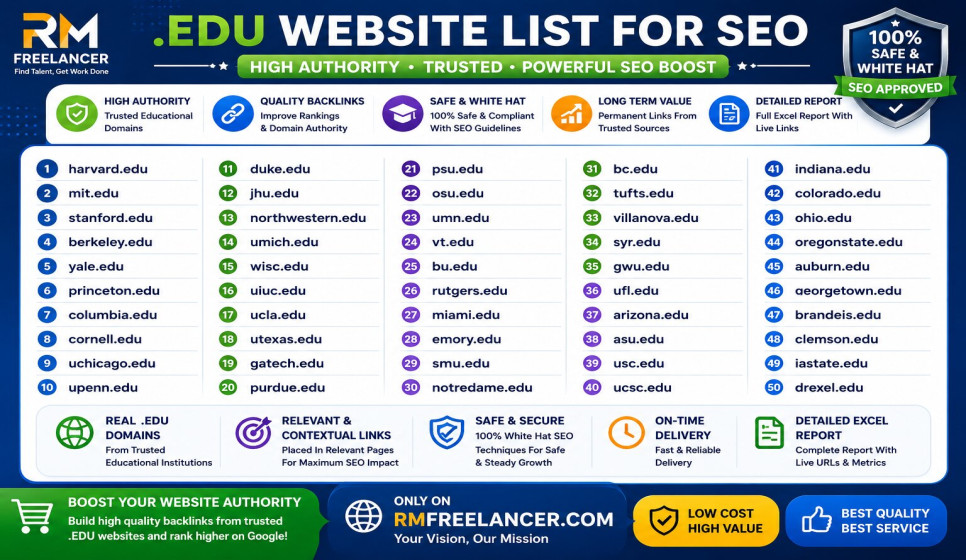
Best Trustable Real EDU Website Examples
Below are examples of well-known educational websites. These are not backlink opportunities by default—they are respected educational institutions.
- Harvard University – https://www.harvard.edu
- Stanford University – https://www.stanford.edu
- Massachusetts Institute of Technology (MIT) – https://web.mit.edu
- University of California, Berkeley – https://www.berkeley.edu
- Yale University – https://www.yale.edu
- Princeton University – https://www.princeton.edu
- Columbia University – https://www.columbia.edu
- Cornell University – https://www.cornell.edu
- Duke University – https://duke.edu
- University of Michigan – https://umich.edu
- University of Washington – https://www.washington.edu
- University of Wisconsin–Madison – https://www.wisc.edu
- Purdue University – https://www.purdue.edu
- Texas A&M University – https://www.tamu.edu
- Penn State University – https://www.psu.edu
- Ohio State University – https://www.osu.edu
- University of Florida – https://www.ufl.edu
- Arizona State University – https://www.asu.edu
- University of Illinois Urbana-Champaign – https://illinois.edu
- Virginia Tech – https://vt.edu
These institutions are recognized worldwide for education and research.
Ethical Ways to Earn EDU Backlinks
Instead of looking for shortcuts, consider these legitimate strategies.
1. Publish High-Quality Educational Content
Create:
- Research-based articles
- Industry guides
- Tutorials
- Case studies
- Free learning resources
- Statistics
- Original surveys
Educational websites are more likely to reference content that provides genuine value.
2. Offer Scholarships
Many universities maintain scholarship pages that list external scholarship opportunities.
If your business legitimately offers a scholarship with clear eligibility requirements and a transparent application process, some institutions may choose to include it on their scholarship pages.
3. Create Free Educational Tools
Useful resources include:
- SEO calculators
- Marketing templates
- Academic citation tools
- Learning checklists
- Free software
- Research databases
Helpful resources are more likely to earn natural references.
4. Participate in Academic Events
Partnering with universities through:
- Workshops
- Guest lectures
- Career events
- Conferences
- Research collaborations
can naturally increase visibility and opportunities for mentions.
5. Contribute Expert Knowledge
If you have expertise in your industry, universities may invite professionals to contribute articles, interviews, or educational resources.
Avoid Common SEO Mistakes
Some people search for:
- EDU profile backlinks
- EDU forum backlinks
- EDU comment backlinks
- Automated EDU backlinks
Many of these tactics provide little value or violate website policies. Google recommends focusing on earning links naturally rather than manipulating rankings.
Avoid:
- Automated link-building software
- Spam comments
- Fake profiles
- Purchasing links that violate search engine guidelines
- Excessive anchor text optimization
Characteristics of a Quality EDU Website
A trustworthy educational website generally has:
- Official university ownership
- Regular updates
- Secure HTTPS connection
- Educational purpose
- Original content
- Active faculty or department pages
- Clear contact information
- Strong reputation
These qualities are more important than the .edu extension alone.
Who Benefits from EDU Mentions?
Businesses and organizations that may benefit from legitimate educational mentions include:
- Software companies
- Educational platforms
- Publishers
- Research organizations
- Nonprofit organizations
- Healthcare organizations
- Technology companies
- Digital marketing agencies
- Professional training providers
The connection should always be relevant to the educational audience.
Build a Natural Backlink Profile
A healthy SEO strategy includes links from a variety of trustworthy sources, such as:
- Industry blogs
- News publications
- Business directories
- Professional associations
- Relevant company websites
- Educational institutions (when appropriate)
- Nonprofit organizations
A diverse backlink profile is generally stronger than relying on one type of website.
Focus on Long-Term SEO
Search engine optimization is most successful when it emphasizes:
- High-quality content
- Excellent user experience
- Fast website performance
- Technical SEO
- Helpful resources
- Genuine relationships
- Ethical link earning
Rather than trying to collect as many .edu backlinks as possible, invest in creating content that educational institutions genuinely want to reference.
Frequently Asked Questions (FAQs)
ANSWER:
A genuine EDU website refers to a website that is operated by a legitimate educational institution, such as a college, university, or other recognized educational organization.
It's important to remember that just because a website has the .edu domain doesn't automatically mean it is trustworthy or authoritative. The real value of such a website lies in the quality and relevance of the content it provides, rather than the domain name itself.
2.
Why are real EDU websites useful for SEO?
ANSWER:
Educational websites can be very beneficial for search engine optimization (SEO) because they can offer valuable backlink and outreach opportunities.
If a website is both legitimate and contextually relevant, a link from it can enhance your backlink profile. Search engines can better understand the connections between different websites, which can help boost visibility and credibility.
3.
Does every EDU backlink have high SEO authority?
ANSWER:
Not necessarily.
While the .edu domain might suggest authority, it doesn’t automatically make every backlink from such a site powerful for SEO. What really matters is the specific page where the link is placed, including its relevance to your content, the quality of the information it offers, the editorial context, the overall reputation of the website, and how well the site is maintained and optimized.
4.
How can I identify trustworthy EDU websites?
ANSWER:
To determine if an EDU website is reliable, you should check if it is indeed run by a recognized educational institution. Look for useful and informative content, an active web presence, and a strong, credible reputation. It's also important to evaluate the specific page where a backlink might appear to ensure it is relevant, high-quality, and aligned with your goals.
5.
Can an EDU website list guarantee higher Google rankings?
ANSWER:
No, simply having a list of EDU websites does not ensure better rankings.
Ranking on Google is influenced by a variety of factors, including the quality and relevance of your content, technical optimization, competition, and the overall strength of your backlink profile. A backlink alone, regardless of its source, does not guarantee improved search results.
6.
Is buying links from EDU websites safe?
ANSWER:
Purchasing links from EDU websites just because they have a .edu domain can be risky.
This is especially true if the links are created specifically to manipulate search rankings. It's generally safer and more sustainable to focus on earning editorial mentions or links that are naturally earned through valuable content and genuine outreach efforts.
7.
What types of EDU pages are useful for link building?
ANSWER:
Pages such as university resource pages, academic research, publication articles, student guides, educational content, scholarship information, and other institution-related resources can be beneficial for link building, provided the link is relevant and appropriate for the content being shared.
8.
Should I use an EDU website list for outreach?
ANSWER:
Yes, using a well-researched EDU website list can help identify relevant educational institutions and resources for outreach. However, it's important to verify each website individually and personalize your outreach rather than sending generic, mass messages. Requesting irrelevant links can harm your credibility and the relationship with the site.
9.
How many EDU backlinks should I build?
ANSWER:
There is no set number of EDU backlinks that can guarantee SEO success.
Instead of focusing on a specific quantity, it's better to prioritize a smaller number of high-quality, relevant, and credible opportunities. Building a diverse backlink profile is more effective than chasing a large number of links from a single source.
10.
What is the best way to use a real EDU website list?
ANSWER:
The best approach is to use such a list as a research tool for legitimate SEO outreach.
Create valuable content that is relevant to the educational institution or resource you’re targeting, and follow each site’s policies closely. Always aim for links that make sense for users, and ensure that quality, relevance, and authenticity remain your top priorities.
Final Summary,
Real .edu websites are trusted because they are associated with genuine educational institutions that provide meaningful academic and research materials. Even though links from these authoritative educational sites can boost a strong backlink profile, their real value lies in the quality, relevance, and reliability of the content they offer—not just the fact that they end with .edu.
The most effective way to gain recognition and credibility is by creating high-quality content that truly benefits users, forming genuine connections with educational organizations, and earning citations in a natural and authentic way. This approach not only supports long-term SEO success but also aligns with best practices for search engines. t helps establish a reliable and trustworthy online reputation that endures over time.


