27
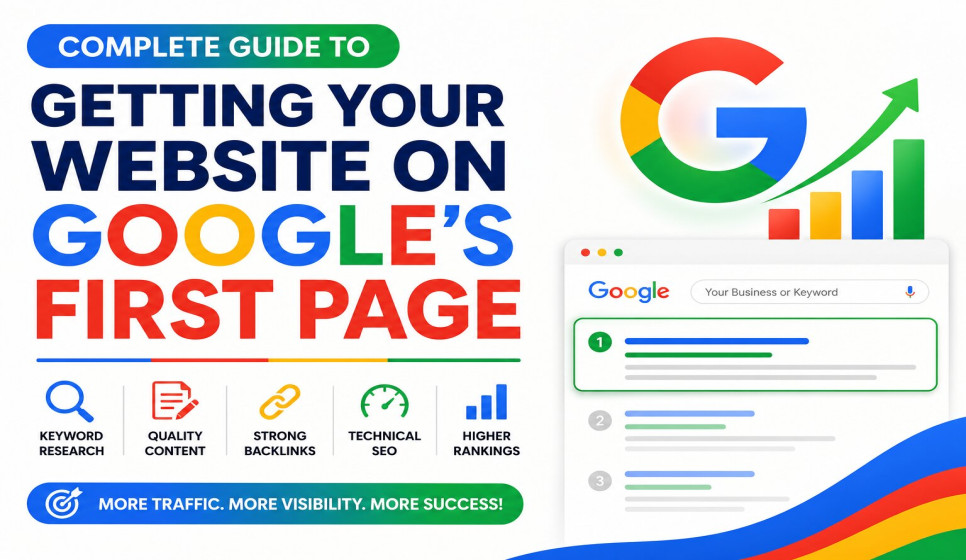
JulComplete Guide to Getting Your Website on Google's First Page
Optimize Your On-Page SEO
Every page should be properly optimized.
Use an SEO-Friendly Title
Include your primary keyword naturally.
Example:
Complete Guide to Getting Your Website on Google's First Page
Write a Compelling Meta Description
Although meta descriptions do not directly affect rankings, they improve click-through rates.
Example:
"Learn proven SEO strategies to rank your website on Google's first page with keyword research, quality content, technical SEO, and effective link building."
Use Proper Heading Structure
Organize your content with:
- H1 for the page title
- H2 for major sections
- H3 for supporting topics
This improves readability and helps search engines understand your content.
Optimize Your URLs
Keep URLs:
- Short
- Descriptive
- Keyword-focused
Good example:
example.com/google-first-page-guide
Avoid unnecessary numbers and random characters.
Improve Website Speed
Page speed affects both user experience and SEO.
To improve loading speed:
- Compress images
- Enable browser caching
- Minify CSS and JavaScript
- Use fast hosting
- Reduce unnecessary plugins
- Use a content delivery network (CDN) if appropriate
A faster website often results in lower bounce rates and better engagement.
Make Your Website Mobile-Friendly
Google primarily uses the mobile version of websites for indexing and ranking.
Ensure your website:
- Uses responsive design
- Loads quickly on smartphones
- Has readable fonts
- Has easy navigation
- Uses properly sized buttons
A poor mobile experience can hurt rankings.
Focus on User Experience
Google values websites that provide a positive experience.
Improve:
- Navigation
- Internal linking
- Readability
- Page design
- Accessibility
- Clear calls to action
Users should quickly find the information they are looking for.
Build High-Quality Backlinks
Backlinks remain one of Google's strongest ranking factors.
Focus on earning links from relevant and reputable websites.
Popular link-building strategies include:
- Guest posting
- Editorial mentions
- Digital PR
- Resource pages
- Broken link building
- Partnerships
- Industry directories
- High-quality profile links where appropriate
Avoid buying spammed or low-quality links, as they can harm your website over time.
Strengthen Internal Linking
Internal links help:
- Search engines discover pages
- Distribute authority throughout your website
- Improve navigation
- Increase time spent on your site
Whenever you publish new content, link it to related pages on your website using descriptive anchor text.
Optimize Images
Images should improve your content without slowing it down.
Best practices include:
- Compress image files
- Use descriptive file names
- Add informative alt text
- Use modern image formats where supported
- Match images to the surrounding content
Improve Technical SEO
Technical SEO helps search engines crawl and index your website efficiently.
Important areas include:
XML Sitemap
Submit an XML sitemap through Google Search Console.
Robots.txt
Ensure important pages are not accidentally blocked.
HTTPS
Secure your website with an SSL certificate.
Canonical Tags
Prevent duplicate content issues by specifying the preferred version of a page.
Structured Data
Use schema markup where relevant to help search engines better understand your content and become eligible for rich search results.
Use Google Search Console
Google Search Console helps you monitor your website's search performance.
Track:
- Search impressions
- Clicks
- Average position
- Indexing status
- Core Web Vitals
- Crawl errors
Regularly review the data to identify opportunities for improvement.
Track Performance with Analytics
Use analytics software to understand:
- Visitor behavior
- Top-performing pages
- Bounce rate
- Engagement
- Traffic sources
- Conversion rates
Use these insights to improve content and user experience.
Publish Content Consistently
Websites that consistently publish useful content often perform better over time.
Create a content calendar covering topics related to your niche.
Examples include:
- How-to guides
- Tutorials
- Industry news
- Case studies
- FAQs
- Product comparisons
- Expert insights
Fresh, relevant content can attract repeat visitors and new backlinks.
Optimize for Search Intent
Before creating content, understand why someone is searching.
Common types of search intent include:
- Informational
- Navigational
- Commercial
- Transactional
Your content should align with the user's intent instead of simply repeating keywords.
Improve E-E-A-T
Google emphasizes Experience, Expertise, Authoritativeness, and Trustworthiness (E-E-A-T).
Strengthen these signals by:
- Publishing accurate information
- Demonstrating real experience
- Citing trustworthy sources where appropriate
- Maintaining an updated About page
- Providing contact information
- Keeping content current
Avoid Common SEO Mistakes
Common mistakes include:
- Keyword stuffing
- Duplicate content
- Slow loading pages
- Broken links
- Poor mobile usability
- Low-quality backlinks
- Thin content
- Ignoring technical issues
- Over-optimizing anchor text
- Neglecting user experience
Avoiding these issues helps build a stronger foundation for long-term rankings.
Be Patient and Consistent
SEO is a long-term strategy. Depending on your competition, niche, and website authority, meaningful improvements may take several months. Focus on publishing helpful content, improving your site's technical health, and earning quality backlinks consistently rather than looking for shortcuts.
Conclusion,
To get your website listed on the first page of Google, you need to combine several key elements: high-quality content that truly helps users, careful keyword research to target the right searches, proper on-page optimization to make your content easy for search engines to understand, technical SEO to ensure your website runs smoothly, a fast and mobile-friendly design, and trustworthy backlinks from other reliable websites.
There is no quick fix or guaranteed way to jump straight to the top, but websites that regularly offer real value to visitors and follow SEO best practices tend to see better search rankings over time. Think of SEO as a continuous effort—creating useful content, improving your website regularly, and tracking how well your efforts are working. By doing this consistently, you’ll gradually build a stronger position in Google Search and attract more visitors to your site.


