26
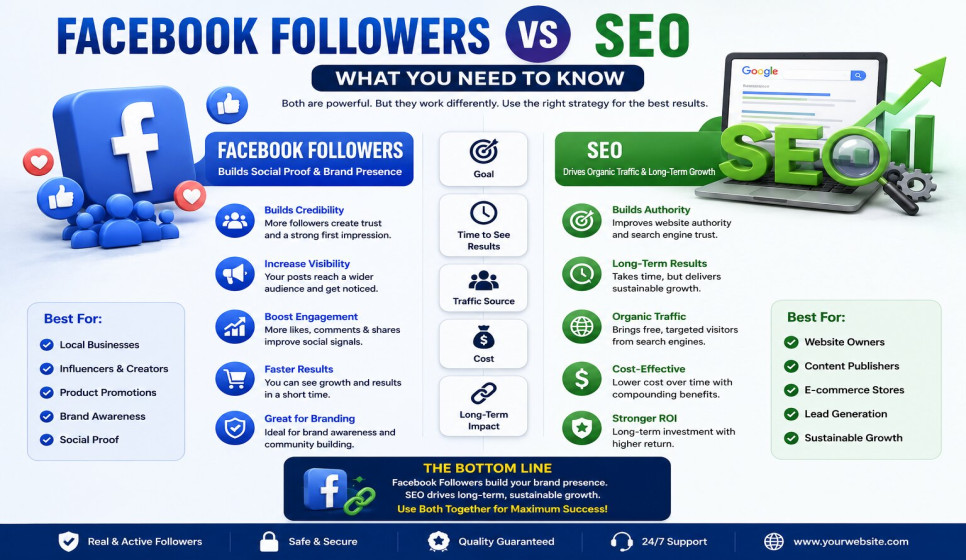
JulFacebook Followers vs SEO: What You Need to Know
Businesses and marketers frequently wonder if having a large number of Facebook followers can help boost their website's rankings on Google. As social media continues to be a key part of digital marketing, it's easy to think that a big following on Facebook directly affects how well a website performs in search engine results .However, the connection between Facebook followers and search engine optimization (SEO) is not as straightforward as it might seem.
While Facebook followers themselves are not something Google uses directly to rank websites, maintaining an active and engaging presence on Facebook can still be a valuable part of a broader marketing plan. It's important to understand the differences between social media growth and SEO so that you can allocate your time and resources in the most effective way possible.
Let’s start by understanding what Facebook followers are.
Facebook followers are individuals who choose to follow a page or profile, allowing them to see updates, interact with the content, and even share posts with others.
A growing follower count can offer several benefits for a business:
- Helps build brand awareness
- Increases perceived credibility
- Expands the reach of your audience
- Provides a platform to promote products and services
- Enables content to be shared with more people
- Strengthens relationships with customers
However, it's important to note that the number of followers alone doesn’t necessarily determine the success of your marketing efforts. It’s more about how you engage with those followers and how effectively you use them as part of your overall strategy.
Now, let’s look at what SEO actually means.
Search Engine Optimization (SEO) refers to the practice of optimizing a website so that it ranks higher in search engine results for relevant searches.
This process involves many different factors, including:
- Creating high-quality, valuable content
- Optimizing content with the right keywords
- Ensuring the website performs well technically
- Designing a mobile-friendly layout
- Making sure pages load quickly
- Enhancing the overall user experience
- Implementing internal linking strategies
- Building high-quality backlinks from other websites
- Using a secure HTTPS connection
- Providing accurate and relevant information
Google considers hundreds of signals when deciding where to place a page in its search results. This means that SEO isn't just about one or two factors but about a wide range of elements that contribute to how well a website is perceived and ranked.
So, are Facebook followers a direct ranking factor for Google?
The straightforward answer is no. Google has made it clear that follower counts and likes on social media platforms like Facebook are not direct signals used to determine search rankings. Having a huge following on Facebook doesn't automatically mean your website will appear higher in Google Search results.
To give you a better idea, consider a few examples:
- A page with 100,000 Facebook followers might still struggle to rank well if the website has poor content and lacks solid technical SEO.
- A smaller business with great content, strong backlinks, and a fast-loading website could easily outrank a larger competitor that has far fewer followers on social media.
In summary,
while SEO and social media are both important aspects of digital marketing, they serve different purposes. SEO focuses on making your website more visible and valuable in search results, while social media helps you connect with your audience and promote your brand. Understanding the roles of both can help you develop a more effective and balanced online marketing strategy.
Facebook offers support to SEO in an indirect manner, even though it doesn't directly affect search engine rankings. Here’s how it can positively influence your SEO efforts over time:
One of the key ways Facebook contributes to SEO is by increasing brand awareness. Every time you post on Facebook, you’re introducing your business to a wider audience. As more people become familiar with your brand, they are more likely to take several actions that can benefit your online presence. For example, they might search for your business name on Google, visit your website, recommend your company to others, or share your content with their friends and followers. Over time, this increased recognition can lead to more traffic coming to your website, which is a valuable asset for your online success.
Another important benefit is the boost in website visitors.
When you share your blog posts, product pages, or educational content on Facebook, it can drive a significant amount of referral traffic to your website. More visitors mean more opportunities for various marketing goals, such as generating leads, making sales, encouraging newsletter sign-ups, and improving customer engagement. While simply having more traffic doesn’t guarantee higher rankings, attracting the right kind of audience can be a strong support for your overall marketing strategy.
Facebook also plays a crucial role in content distribution.
Publishing useful and engaging content is just one part of content marketing. Facebook helps spread that content further by sharing it with your existing followers, reaching new audiences through social shares, and connecting with customers and industry communities. As your content gets seen by more people, it becomes more likely that it will be noticed by other websites, bloggers, or journalists who might naturally reference or link to it, which is a big boost for SEO.
Lastly, repeated exposure to your business on Facebook can lead to increased brand searches. When people regularly see your brand on the platform, they might later search for your company on Google. These brand searches can be a sign that your marketing efforts are working, as they show people are familiar with your business and are actively looking for it. This kind of recognition is often a result of successful marketing campaigns and can influence both brand visibility and search behavior.
What Actually Improves Google Rankings?
Rather than focusing solely on increasing the number of Facebook followers, it's better to invest in proven strategies that support Search Engine Optimization (SEO). Let's explore the key factors that contribute to better Google rankings.
High-Quality Content
Creating content that answers users' questions in a clear and accurate way is essential. Content that offers real value and addresses the needs of your audience tends to perform better than content that is written primarily to target specific keywords.
Examples of valuable content include:
- Tutorials that explain how to do something
- Buying guides that help people make informed purchasing decisions
- Industry news that keeps your audience updated on the latest trends
- Case studies that showcase real-life examples of success
- Product comparisons that help users evaluate different options
- Frequently asked questions (FAQs) that address common concerns
Keyword Research
Understanding what your audience is searching for is an important part of SEO.
Use keyword research tools to identify the terms and phrases that people are using to find information related to your business.
When incorporating keywords into your content, make sure to do so naturally and avoid overstuffing.
Use keywords in headings, subheadings, and throughout the body of your content in a way that feels natural and adds value.
Technical SEO
Your website's technical performance plays a significant role in how search engines perceive and rank your content.
A well-optimized website should be:
- Fast-loading, so users don't have to wait too long to access the information they need
- Mobile-friendly, as more people are browsing the web on their phones
- Secure, using HTTPS to protect users' data
- Easy to navigate, so visitors can find what they're looking for without difficulty
- Properly indexed, ensuring that search engines can access and understand all the pages on your site
Improving your website's technical SEO helps search engines crawl and understand your content more effectively.
Quality Backlinks
Backlinks, or links from other websites to your site, are one of the strongest signals that Google uses to determine a website's authority and relevance.
To build high-quality backlinks, focus on creating content that is valuable and worth sharing.
This can include:
- Writing guest articles for reputable websites in your industry
- Engaging in digital public relations (PR) to get your content featured in media outlets
- Partnering with other businesses or influencers in your field
- Publishing original research that provides insights or data that others will want to reference
Avoid using spammed or unethical link-building tactics, as these can lead to penalties from search engines.
Excellent User Experience
Google aims to show users the most relevant and useful results.
To improve your website's user experience, make sure it is:
- Easy to navigate, with clear menus and intuitive design
- Visually appealing, with a clean and professional layout
- Easy to read, using clear fonts, good contrast, and well-structured paragraphs
- Fast-loading, so users don't become frustrated waiting for pages to load
- Accessible, making sure it's easy for people of all abilities to use
- Easy to find contact information, so users can reach out if they have questions
Providing a positive user experience is essential for both user satisfaction and performing well in search results.
Why Facebook Still Matters?
While Facebook followers do not directly influence Google rankings, Facebook remains an important tool for business growth.
It can help you:
- Build trust with your customers by showcasing your brand and values
- Strengthen your brand's presence online by creating a consistent image
- Reach local communities and engage with people in your area
- Announce promotions and special offers to your audience
- Share educational content that helps your followers learn something new
- Collect feedback from your customers to improve your products and services
- Increase engagement by encouraging interaction through comments and shares
Social media and SEO should work together, not compete.
Each plays a unique role in helping your business succeed online.
Common Misconceptions
Myth 1: More Followers Mean Higher Google Rankings
The number of followers you have on Facebook does not directly affect how your website ranks in Google. What matters more is the quality and relevance of your content, along with other SEO factors.
Myth 2: Buying Followers Improves SEO
Purchasing followers on Facebook may seem like a quick way to increase your audience, but it won't improve your website's ranking.
In fact, it can hurt your credibility.If you choose to use promotional services, make sure they comply with Facebook's policies and prioritize building a genuine, engaged audience over just increasing numbers.
Myth 3: Viral Posts Guarantee SEO Success
A viral Facebook post may generate a lot of attention, but it doesn't guarantee long-term SEO success. SEO success is built on the quality of your website, the depth of your content, and the overall optimization of your online presence.
Myth 4: Social Media Replaces SEO
Social media and SEO have different purposes.
SEO helps people find your website through search engines, while Facebook helps people discover your business through social interactions and content sharing.The most successful digital marketing strategies combine both approaches.
Best Practices for Combining Facebook and SEO
To get the best results from your social media and SEO efforts, it's important to integrate them effectively.
Here are some practical strategies:
- Share every new blog post or article on your Facebook page to expand your reach
- Create engaging images and videos that encourage your followers to share your content
- Include clear links from your Facebook posts to the corresponding pages on your website
- Maintain a consistent brand voice across your website and social media profiles
- Respond to comments and messages to build a sense of community and trust
- Publish original and useful content that people want to recommend and share
- Track referral traffic and engagement metrics to see which types of content perform best
- Keep your Facebook page, website, and contact information up to date for consistency
By combining these strategies, you can create a more cohesive and effective online presence.
Measuring Success
Instead of focusing only on the number of followers you have on Facebook, it's better to monitor a variety of performance metrics that give a more complete picture of your marketing efforts.
These include:
- Website traffic: the number of people visiting your website
- Organic search visibility: how well your website appears in search engine results
- Conversion rate: how many visitors take a desired action, such as making a purchase or signing up
- Time spent on pages: how long visitors stay on your website
- Engagement on Facebook: how much interaction your posts receive
- Referral traffic from social media: how much traffic comes from your social media platforms
- Newsletter sign-ups: how many people are interested in receiving updates from your business
- Sales and leads: how many customers you're converting into actual sales
- Brand mentions: how often your brand is mentioned online
- Customer inquiries: how many questions or requests your business receives from customers
These indicators can help you assess the effectiveness of your marketing strategies and make data-driven decisions.
Conclusion,
Facebook followers and SEO play different but complementary roles in digital marketing. A large Facebook audience can increase brand awareness, expand the reach of your content, and drive more visitors to your website. However, the number of followers you have is not a direct factor in how your website ranks in Google.
If your goal is long-term online success, focus on creating high-quality content, improving your website's technical performance, earning reputable backlinks, and providing an excellent user experience. At the same time, use Facebook to engage your audience, promote valuable content, and strengthen your brand.
By combining a thoughtful Facebook strategy with strong SEO practices, businesses can build a more visible, trusted, and sustainable online presence over time.
If you have any questions or concerns, please contact us:
Website: https://rmfreelancer.com/
Email: support@rmfreelancer.com
Phone: +1 307-243-8976
RMFreelancer Office:
30 N Gould St, Ste R, Sheridan, WY 82801, USA


