09
OctFreelance Local SEO Growth Through Smarter Location Targeting
The Necessity of Strategic Location Targeting
Businesses may cater to a single city, multiple neighborhoods, a broader region, or clients traveling from various locations. Each scenario leads to distinct search behaviors. While local residents might search based on their neighborhoods, visitors often reference nearby landmarks, and those in urgent need prioritize proximity and availability. A national keyword strategy fails to account for these variations.
Effective targeting begins with practical business considerations. Which locations yield profitable work? Which areas can the team service reliably? Are there regions with high demand yet limited visibility? Additionally, are there locations crucial for future growth?
This approach fosters a cohesive strategy rather than a mere assortment of disconnected local tactics.
Understanding Local Search Behavior
Conducting local keyword research should encompass services, products, neighborhoods, landmarks, inquiries, urgency phrases, and terms that reflect availability.
It's important to categorize search intent. Some searches aim for information, while others compare options, and some indicate readiness to call, book, visit, or purchase. Location targeting gains significance when content and landing pages cater to these varying stages without forcing every visitor into a uniform message.
Select Locations Based on Potential
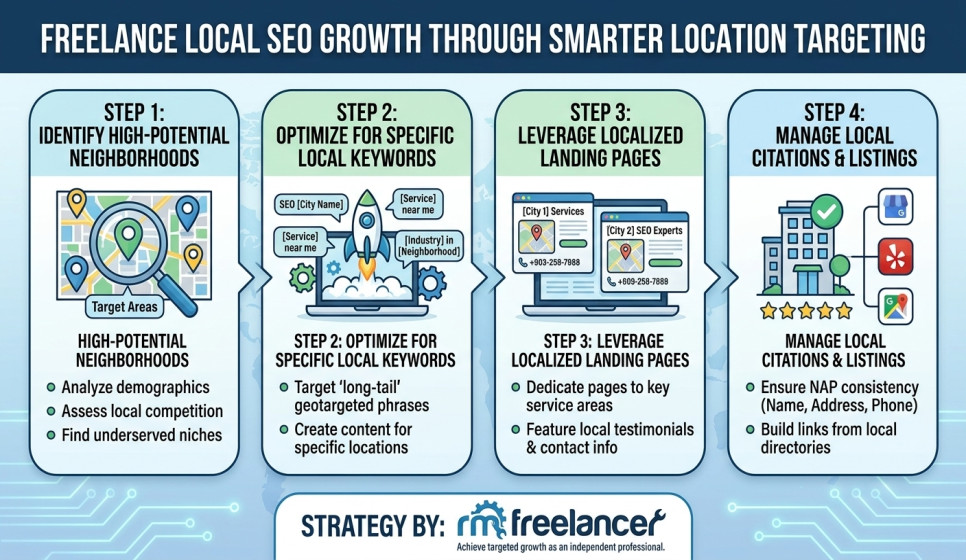
Not every nearby location warrants a dedicated landing page. When selecting locations, consider demand, competition, travel feasibility, existing customers, profitability, and the quality of information the business can provide. A page that lacks distinctive value may instead clutter search results without enhancing visibility.
A location opportunity model can assess areas based on commercial potential and implementation efforts. High-demand locations with solid service coverage may require immediate focus, while smaller areas might be adequately served via a well-crafted regional page, internal links, and a comprehensive business profile.
This approach helps to sidestep doorway content, where numerous pages recycle nearly identical text, with only the place name modified. Searchers seek specific reasons to trust a business in their vicinity—not artificial variations of a generic statement.
Develop Valuable Location Pages
An effective location page should address the inquiries local customers might have. It should provide details on available services, response areas, directions, parking options, delivery limits, appointment procedures, local expertise, customer expectations, and practical contact methods. Ensure that all information is accurate and updated when operations shift.
Diverse locations may require tailored content due to factors like customer needs, competitive landscape, and service availability. One area might need emergency services, while another may focus on scheduled consultations. Local examples, testimonials, regulations, and frequently asked questions can enhance a page's value if they are authentic.
The page should clearly guide visitors to the next step, whether that's a phone call, booking form, store visit, quote request, or product inquiry. Clear headings, readable text, internal links, accessible controls, and mobile responsiveness make the page more user-friendly.
Optimize Google Business Profiles with Care
The Google Business Profile serves as a crucial local discovery point. Ensure that the business name, primary category, address, service area, contact number, hours of operation, website, services offered, photos, and appointment links accurately reflect the business's activities. Inaccurate details can lead to confusion and diminished trust.
Freelancers should verify duplicate profiles, ownership, category selections, holiday hours, responses to customer questions, updates, and review activities. Service-area businesses must clearly outline coverage per relevant guidelines, whereas businesses with physical premises should make details about entrance, parking, accessibility, and contact information understandable when applicable.
Profile enhancements should be evaluated through metrics such as calls, clicks to the website, requests for directions, messages, bookings, and inquiries, rather than merely focusing on views. Local ranking positions fluctuate depending on the searcher's location and cannot be guaranteed.
Establish Consistent Location Signals
Search engines assess business details across websites, directories, review platforms, social media profiles, local organizations, and industry sources. Inconsistencies like different spellings, outdated phone numbers, previous addresses, and varying hours can breed uncertainty.
Conducting a citation audit identifies significant discrepancies and emphasizes credible, relevant platforms. The aim is not to list the business everywhere but to maintain accurate information where customers and search engines are likely to seek it. Changes should be logged after relocations, rebranding, mergers, or updates to service areas.
Location signals also encompass internal links, page titles, headings, structured data, local references, and contact details. Consistency doesn't imply repetitive phrasing; rather, it involves clearly conveying the same reality across valuable touchpoints.
Utilize Local Content Purposefully
Local content can showcase expertise while addressing genuine questions. A business might discuss seasonal service needs, local regulations, delivery options, preparation steps, neighborhood specifics, or common mistakes. The topic should provide value, even if the reader doesn't convert immediately.
Community-focused content can also foster relationships. Relevant events, collaborations, local media, industry groups, and organizations can yield authentic mentions and referral opportunities. Outreach should emphasize shared benefits rather than mass link requests.
Content should genuinely support the selected locations and services without pretending to be locally relevant. Specific anecdotes, practical information, and accurate guidance are more compelling than merely repeating place names.
Strengthen the Technical Foundation
Local landing pages must be easily crawlable, indexable, fast, and accessible. A technical review should assess navigation, XML sitemaps, canonical tags, robots directives, redirects, status codes, structured data, mobile usability, and internal linking. Essential pages should be accessible through meaningful paths and not solely exist in a sitemap.
Performance enhancements should prioritize service pages, location pages, contact forms, booking processes, and product templates. Optimizing images, implementing caching, improving server performance, reducing scripts, and prioritizing font delivery can ease access for mobile users. Accessibility improvements, such as clear headings, labeled forms, adequate contrast, keyboard support, and descriptive links, help a broader audience accomplish local tasks.
Location schema can provide context about a business, service, organization, or address when it aligns with visible information. While markup aids comprehension, it does not guarantee improved rankings.
Manage Reviews and Cultivate Local Trust
Customer reviews significantly impact trust and reveal how clients perceive the business. A responsible feedback process facilitates authentic reviews, ensures professional responses, and avoids soliciting or fabricating testimonials. Businesses shouldn't pressure customers for specific wording.
Responses can express gratitude, address concerns, clarify subsequent steps, and showcase accountability—all without compromising personal information. Recurring complaints may indicate opportunities to enhance communication, service quality, scheduling, or pricing.
Trust is further bolstered through accurate images, transparent policies, helpful staff details, reliable hours, and consistent customer experiences. Local SEO should reflect reality rather than crafting an attractive but misleading profile.
Assess Location-Level Growth
Reporting should reveal which locations and services yield meaningful results. Track impressions, clicks, map actions, calls, direction requests, bookings, inquiries, sales, and revenue when reliable data is accessible. Analyze performance based on location, device, service, and time frame.
A location dashboard can highlight areas with high demand but low conversion, pages with visibility but poor engagement, and services that attract valuable customers. Rankings provide useful diagnostic information, but they fluctuate based on proximity, personalization, competitive landscape, seasonality, and evolving search demand.
Effective reporting clarifies completed tasks, observed results, uncertainties, customer outcomes, and future priorities. It empowers leadership to invest in locations based on evidence rather than assumptions.
Why Engage a Freelance Local SEO Specialist?
A freelance specialist offers concentrated expertise without unnecessary complexities. Their services can enhance location research, opportunity mapping, profile optimization, content strategy, citation cleanup, technical enhancements, review management, and performance reporting.
The right partner listens to operational boundaries, comprehends customer journeys, avoids unrealistic ranking promises, and transforms complex decisions into actionable steps. If your business faces scattered location pages, inconsistent listings, weak regional presence, or uncertainty regarding growth opportunities, smarter targeting can uncover the most promising areas.
By aligning services, locations, customer intent, and credible information, a freelance local SEO approach can convert geographic reach into sustainable growth. The outcome is more than mere map impressions; it establishes a clearer route from local discovery to meaningful engagement, stronger relationships, and profitable long-term business success.
Frequently Asked Questions (FAQs)
What is local SEO location targeting?
ANSWER:
Location targeting concentrates local SEO efforts on the areas, neighborhoods, cities, or service regions where a business can realistically serve customers and generate valuable demand.
Why is location targeting vital for local businesses?
ANSWER:
It enables businesses to connect services with relevant nearby searches, avoids wasted efforts in unsuitable areas, and facilitates the creation of content that mirrors real customer needs and operational scope.
Does each service area need its own page?
ANSWER:
No, a separate page is only beneficial when it provides unique information about services, customers, directions, availability, or local conditions. Duplicated pages with altered place names offer little value.
How do I select locations for local SEO?
ANSWER:
Take into account factors such as customer demand, competition, profitability, travel feasibility, existing clientele, service availability, and the quality of useful information that can be offered for each location.
How does Google Business Profile support local growth?
ANSWER:
It showcases critical business information on Google Search and Maps, including categories, operating hours, services offered, photos, reviews, directions, and contact options, which encourage customers to take action.
Can local SEO assist businesses serving multiple cities?
ANSWER:
Yes, a structured strategy can effectively organize service areas, create genuinely useful location pages, maintain accurate profiles, enhance internal linking, and track results by city and service.
Do local reviews impact location targeting?
ANSWER:
Reviews affect trust and reflect the language customers use when describing services. Authentic feedback can inform profile content, website subjects, service enhancements, and reputation management.
How long does it take for local SEO growth to manifest?
ANSWER:
Timing varies based on competition, location, website quality, reputation, demand, and the initial condition of the business. Consistent improvements typically outperform short-lived ranking tactics.
What should location pages contain?
ANSWER:
Effective location pages should include services, coverage areas, directions, contact options, availability, local examples, testimonials, FAQs, parking information, delivery specifics, and clear next steps.
Why hire a freelance local SEO specialist?
ANSWER:
A freelancer offers focused research, location strategy, profile optimization, content guidance, technical support, citation management, and tailored reporting to suit the business’s market and objectives.
If you have any questions or concerns, please contact our friendly support team for immediate assistance.
Website: https://rmfreelancer.com/
Email: support@rmfreelancer.com
Phone: +1 307-243-8976
RMFreelancer Office:
30 N Gould St, Ste R, Sheridan, WY 82801, USA


