16
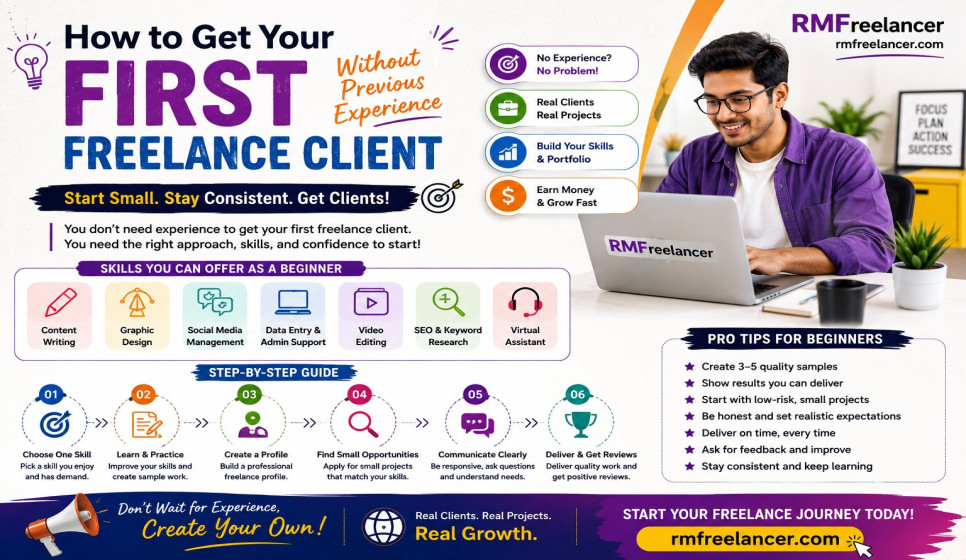
AugHow to Get Your First Freelance Client Without Previous Experience
Starting Freelancing Without Previous Experience: A Guide
Embarking on a freelancing career without any prior professional experience may appear daunting, especially given that numerous clients often seek seasoned experts. However, every accomplished freelancer had to begin their journey at some point. You don’t require years of expertise to secure your initial client; what you need is a valuable skill, a defined service, a polished presentation, and the resolve to continually enhance your abilities.
Securing your first freelance client can be particularly challenging as you work on developing your portfolio and establishing your reputation. Once you complete a few projects and gain positive reviews, discovering additional opportunities may become more straightforward. The essential focus should be on demonstrating your capabilities rather than merely proclaiming your skills to potential clients.
Here are practical steps that can assist you in acquiring your first freelance client without prior experience.
1.
Select One Freelance Service
Before you start seeking clients, clarify the specific service you intend to provide. Avoid presenting yourself as a jack-of-all-trades. A targeted service makes it simpler for clients to comprehend what you offer.
Beginners can consider services such as:
Content writing
Data entry
Virtual assistance
Social media management
Graphic design
Video editing
Online research
Translation
Basic SEO
Customer support
Pick an area that aligns with your current skills and interests. If you have a passion for writing, content creation could be a fitting starting point. If you excel at organization, virtual assistance may be your best option.
2.
Acquire Essential Skills
You don’t need to master an entire field before seeking your first assignment. However, you should grasp the basic requirements of the service you plan to offer.
For instance, a budding content writer should familiarize themselves with grammar, formatting, research, and fundamental SEO concepts. A virtual assistant should understand how to manage documents, spreadsheets, emails, and online research.
Dedicate time to practicing your chosen skill prior to reaching out to clients. Utilize free tutorials, practice assignments, and personal projects to build your confidence.
3.
Develop Samples for Your Portfolio
One of the primary challenges faced by new freelancers is the absence of prior work to showcase. The solution lies in creating your own samples.
You don’t need a paying client to construct a portfolio.
A writer can produce several original articles. A graphic designer can craft sample social media posts or banners. An SEO freelancer can conduct a mock website audit. A virtual assistant can build a sample spreadsheet or compile a research report.
Ensure your samples are realistic and professional. Your portfolio should reflect what you are genuinely capable of delivering to a client.
4.
Establish a Professional Freelance Profile
Your freelance profile often serves as the initial impression for prospective clients. Keep it straightforward, truthful, and centered on the service you provide.
Use a professional title that clearly articulates your role. Instead of saying, "I can perform various online jobs," use a specific description like "Beginner SEO Content Writer" or "Virtual Assistant for Small Businesses."
Your profile description should clarify:
The service you provide
Your target audience
The tasks you can complete
The tools you utilize
What clients can anticipate from you
Avoid misrepresenting your experience. Honesty fosters trust.
5.
Commence with Small Projects
Your initial project doesn’t have to be a significant undertaking. Smaller assignments can be excellent opportunities to demonstrate reliability and gain experience.
Seek tasks that align with your current skills and can be accomplished within a reasonable timeframe.
Successfully completing smaller assignments can help you build confidence, receive feedback, and produce examples of real client work, which you can later apply towards larger projects.
6.
Craft Personalized Proposals
When applying for freelance jobs, refrain from submitting the same proposal to each client. Generic applications may give the impression that you lack interest in the specific project.
Instead, carefully review the client's needs and explain how you can address them.
A straightforward proposal could include:
Introduction:
A brief introduction of yourself and your service.
Understanding:
Demonstrate that you comprehend the client’s needs.
Solution:
Outline how you would tackle the project.
Evidence:
Reference relevant portfolio samples or practice work.
Closing:
Encourage the client to discuss the project further.
Keep your proposal professional and concise. Clients prefer to quickly ascertain whether you grasp their requirements.
7.
Center on the Client's Needs
One of the most effective strategies to set yourself apart is to concentrate less on yourself and more on the client's challenges.
Instead of stating, “I am a dedicated freelancer and I need experience,” articulate what you can do for the client.
For example, a content writer could emphasize their ability to create structured, original articles tailored to the client's target audience. A virtual assistant could clarify how they can streamline repetitive administrative tasks.
Clients hire freelancers to solve problems, so showcase your understanding of their needs.
8.
Provide Competitive Beginner Pricing
Setting your prices can be tricky when lacking a professional background. You might need to start with competitive rates while you build your reputation.
However, refrain from offering excessively low prices solely because you are a newcomer. Your time and expertise are still valuable.
Research similar services and factor in the complexity of the project, the time required, and the expected deliverables. As you accumulate positive reviews and improve your skills, consider gradually raising your rates.
9.
Leverage Your Existing Network
Your first client doesn’t necessarily need to come from a large freelance platform. Individuals in your personal network may provide your inaugural opportunity.
Inform friends, former classmates, professional connections, local businesses, or online communities about your services when appropriate.
For instance, if you offer social media services, a small business owner in your circle might require assistance with content creation. If you write articles, someone you know may need web content.
Your existing network can open doors because people familiar with you may be more inclined to take a chance.
10.
Enhance Your Online Presence
Having an online presence can help potential clients discover your abilities. Depending on your service, you can showcase your work through a portfolio website, professional social media profiles, or relevant online communities.
Share insightful information relevant to your field. A beginner SEO freelancer could discuss basic optimization tactics. A designer might display original projects. A writer could publish informative articles.
Exhibiting knowledge publicly can help establish credibility even before you have an extensive client history.
11.
Demonstrate Reliability and Clear Communication
Technical skills are merely one aspect of freelancing. Professional conduct can make a significant difference.
Respond to inquiries in a timely manner. Confirm project details before starting. Be upfront about deadlines and provide updates when necessary.
If issues arise, communicate them promptly rather than disappearing.
A newcomer who communicates effectively and meets deadlines could leave a stronger impression than a more experienced freelancer who fails to be dependable.
12.
Solicit Feedback After Project Completion
Once you successfully complete your first assignment, request feedback from the client if the platform or arrangement allows it.
Positive feedback can enhance your profile and reassure future clients when considering hiring you.
You can also inquire with satisfied clients if they require additional related services. A single successful project can sometimes lead to repeat business.
13.
Persist in Applying Despite Rejections
Facing rejection is part and parcel of starting a freelance career. A client may choose another freelancer due to pricing, availability, experience, timing, or personal preference.
Do not interpret every rejection as a signal that you cannot succeed in freelancing.
Instead, review your proposals and portfolio. If you're receiving consistent rejections, consider refining your profile, samples, pricing, or application methods.
Consistency is key. The objective is not to win every project but to identify suitable opportunities.
14.
Continue Advancing Your Skills
Landing your first client is merely the beginning. Treat each project as an opportunity for growth.
Stay updated on industry trends, learn about new tools, practice regularly, and analyze feedback. Gradually, you can progress from basic services to more specialized tasks.
For example, a novice writer might eventually specialize in SEO-focused content. A social media assistant could delve into paid advertising and analytics, while a basic designer might enhance their branding and advanced visual design skills.
Frequently Asked Questions (FAQs)
1. Can I acquire my first freelance client without any professional experience?
ANSWER:
Absolutely. Begin by offering a skill you are comfortable with, generating sample work, and applying for projects that align with your current capabilities. Clients typically prioritize the quality of your work, effective communication, reliability, and your ability to follow instructions.
2. What is the simplest method to find my first freelance client?
ANSWER:
Commence with smaller projects that correspond to your skills. Develop a targeted profile, prepare relevant portfolio samples, and submit personalized proposals for appropriate opportunities instead of applying randomly to every listing.
3. Which freelance services are suitable for beginners?
ANSWER:
New freelancers might consider content writing, data entry, virtual assistance, social media management, online research, basic graphic design, transcription, translation, video editing, and entry-level SEO services.
4. How can I assemble a portfolio without prior clients?
ANSWER:
Create your own demonstration projects. For instance, writers can draft sample articles, designers can produce sample graphics, and aspiring SEO freelancers can carry out a sample website audit. Clearly label these as portfolio samples.
5. Should I disclose to clients that I am a beginner?
ANSWER:
You should be transparent about your experience. However, center your presentation on what you can offer, rather than repeatedly highlighting your lack of experience. Demonstrate your skills through tangible examples and clarify how you can fulfill the project requirements.
6. How should I craft my first freelance proposal?
ANSWER:
Tailor your proposal to the specific project. Illustrate that you comprehend the client's needs, outline your proposed strategy, reference relevant samples, and give a realistic timeline. Refrain from sending a generic message that’s copied for every application.
7. Should novice freelancers charge lower rates?
ANSWER:
Competitive pricing as a beginner can help you secure initial opportunities, but excessively low rates may not always be necessary. Evaluate the time, complexity, and quality needed for the project before determining your price.
8. How many freelance projects should I apply for daily?
ANSWER:
There is no perfect number. Quality outweighs quantity when submitting applications. Concentrate on projects that genuinely match your skills and create personalized proposals that address the client's specific needs.
9. Can I obtain freelance clients through my existing contacts?
ANSWER:
Yes. Your current network can occasionally provide your first opportunity. Friends, former classmates, local businesses, professional connections, and online communities may know someone in need of your services.
10. What should I do if my proposals keep getting rejected?
ANSWER:
Examine your profile, portfolio, pricing, and proposal structure. Ensure you are applying for fitting projects and articulating your value clearly. Rejection is common among new freelancers and can provide valuable insights for improving your approach.
11. How crucial is communication when acquiring a first client?
ANSWER:
Communication is incredibly vital. Respond in a professional manner, clarify requirements, confirm deadlines, and keep the client updated on progress. Strong communication can help mitigate having a limited professional background.
12. Should I accept any project just to gain experience?
ANSWER:
No. Choose projects you can realistically complete to the necessary standard. Accepting work beyond your capabilities can lead to missed deadlines, subpar results, and negative feedback that may hinder future freelancing opportunities.
13. How can I make my freelance profile appealing to clients?
ANSWER:
Utilize a clear professional title, describe one main service, emphasize relevant skills, showcase your strongest samples, and outline the benefits you offer. Keep the information easily comprehensible and avoid making unsupported claims regarding your experience.
14. How can my first freelance project lead to securing more clients?
ANSWER:
Complete the project meticulously, meet the agreed deadline, communicate professionally, and request feedback after successful completion. A pleased client may leave a positive review, recommend you to others, or hire you for additional work.
15. How long does it typically take to land my first freelance client?
ANSWER:
There is no guaranteed timeline. It depends on your skills, services, portfolio, pricing, demand, proposals, and consistency. Some beginners locate opportunities swiftly, while others may need several weeks of effort and applications before securing their first project.
Looking Ahead,
Acquiring your first freelance client without prior experience is attainable when you approach the process deliberately. Choose a specific service, master the fundamentals, develop compelling portfolio samples, create a professional profile, and apply for projects that resonate with your skills.
Concentrate on addressing client challenges rather than stressing your lack of experience. Submit tailored proposals, communicate with professionalism, deliver timely work, and utilize early projects to bolster your credibility.
Finding your first client may require patience, but the experience will lay the groundwork for a thriving freelance career. After completing your initial project, gathering feedback, and refining your skills, you will possess stronger evidence of your capabilities — setting a much improved foundation for securing your subsequent clients.
If you have any questions or concerns, please contact our friendly support team for immediate assistance.
Website: https://rmfreelancer.com/
Email: support@rmfreelancer.com
Phone: +1 307-243-8976
RMFreelancer Office:
30 N Gould St, Ste R, Sheridan, WY 82801, USA


