27
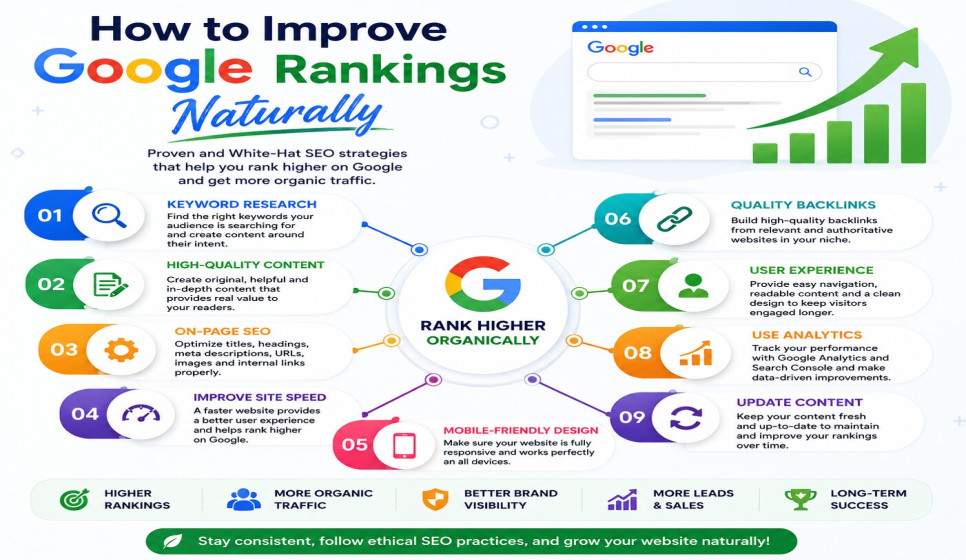
JulHow to Improve Google Rankings Naturally
Improving your website's position in Google's search results naturally is a process that requires patience, regular effort, and a solid understanding of what search engines and users look for. While paid advertising can quickly bring in traffic, relying on organic search visibility can lead to lasting results without the need to pay for each visitor. The main goal is to build a website that is helpful, reliable, easy to use, and technically well-structured.
Google uses a variety of factors to determine how to rank websites, such as the quality of the content you provide, the overall experience visitors have when they come to your site, how relevant your pages are to the search query, and the level of trust and authority your website has built up over time. There isn't a single shortcut or secret formula that will guarantee your site appears at the top of search results. Instead, effective search engine optimization is achieved by consistently applying a range of well-established best practices.
Creating helpful and original content is key to achieving strong rankings on Google.
Your web pages should aim to answer real questions, solve problems, or assist visitors in making informed choices. It's important to avoid creating content solely to include keywords. Google is increasingly focused on whether a page truly fulfills the purpose behind a search.
Before you start writing an article, take time to figure out what your target audience is looking for. Conduct searches for your topic and look at the types of pages that are already ranking high. Pay attention to what these pages cover well and where they might be missing something. This way, you can create something that is more complete, clearer, or more valuable than existing content.
Originality plays a big role in content creation.
Don't just copy or rewrite content from other websites. Instead, add your own explanations, examples, research, case studies, opinions, or practical tips. Content that offers unique value tends to attract more readers, backlinks, and social shares.
It’s better to publish fewer, high-quality articles than a large number of low-quality ones. Each page should have a clear purpose and deliver meaningful information to the reader.
Using keywords effectively is also important.
Keywords help Google understand the main topic of your page, but they should be used in a natural way. Begin by selecting one main keyword and a list of related phrases. Make sure to include the main keyword in the title, introduction, URL, and at least one heading if appropriate. Throughout the article, use related terms where they fit naturally without forcing them.
Avoid keyword stuffing, which is when you overuse the same phrase repeatedly.
This can make your content hard to read and may hurt your rankings. Instead, focus on covering your topic in depth. Search engines can understand related words and concepts, so you don’t need to use the exact keyword in every paragraph.
Also, consider the search intent of your audience.
For example, someone searching for "best running shoes" might be looking for comparisons, while someone searching for "how to clean running shoes" needs step-by-step instructions. Your content should align with what the searcher is trying to find.
Improve Your Website’s Technical SEO
Technical SEO plays a crucial role in helping search engines like Google effectively crawl, understand, and index your website. Even if your content is of high quality and well-written, it may not perform well in search results if the technical aspects of your site are not set up correctly. This means the way your website is structured and how it is presented to search engines is just as important as the content itself.
One of the key elements to focus on is the organization of your website.
It's important that important pages—like your homepage, blog posts, and product pages—are easy to reach through clear navigation menus and internal links. This helps both users and search engines to move through your site in a logical way. Additionally, using descriptive URLs that clearly explain what each page is about, instead of random numbers or complicated symbols, makes it easier for search engines to understand the content of your pages.
Another important consideration is ensuring that your website has a responsive design. A responsive website will adjust its layout to fit the screen size of the device it's being viewed on—whether it's a desktop, tablet, or smartphone. Since a significant portion of internet users access the web via mobile devices, having a poor mobile experience can result in lower user engagement, higher bounce rates, and fewer conversions. A mobile-friendly site not only improves user satisfaction but also helps your site rank better in search results.
Page speed is another critical factor in technical SEO.
A website that loads quickly can provide a better user experience, which is a signal that search engines may consider when determining rankings. To improve page speed, you can compress large images, remove any unnecessary plugins or scripts, choose a reliable and fast hosting service, and optimize your website’s code. These steps can help reduce load times and ultimately support better performance in search results.
It is also important to regularly check for technical issues such as broken links, duplicate pages, missing title tags, and problems with indexing.
These issues can prevent your pages from being properly displayed in search results. Tools like Google Search Console can be very helpful in identifying and fixing such problems. Regular monitoring and maintenance of your website’s technical health can ensure that your content is accessible and visible to search engines.
Write Better Titles and Meta Descriptions
The title of your web page is one of the first things users see when they search for content online. It serves as a key element that can determine whether or not they click on your link. Therefore, it's important to create a title that clearly describes the content of your page and encourages the right audience to visit. Your title should be specific, clear, and directly related to the topic of the page, without sounding forced or overly keyword-stuffed.
For example, a title like "Natural Ways to Improve Google Rankings" is more helpful and informative to users than a vague title like "Online Marketing Tips." The former tells users exactly what they will find on the page, increasing the likelihood that they will click through.
While meta descriptions do not directly impact your search rankings, they can significantly influence the click-through rate (CTR) of your page. A well-written meta description briefly summarizes what users can expect to find on the page and gives them a reason to visit. It is important that your meta description is accurate, relevant, and matches the content of the page. Avoid making promises that are not fulfilled by the actual content, as this can lead to a poor user experience and lower engagement.
Over time, when more users choose your result because it appears useful and relevant, your page can receive stronger engagement signals, which can positively impact your search rankings. By creating clear, accurate, and compelling titles and meta descriptions, you can improve the visibility of your website in search results and increase the chances of users clicking on your links.
Build a Strong Internal Linking System
Internal links are connections between different pages on your website.
These links allow visitors to explore related content and help search engines understand how your pages are connected to each other.
For example, if you write a blog post about improving your website’s speed, you could include a link to another article that discusses image optimization.
This helps visitors find additional useful information and makes it easier for search engines to see how your content is related.
It’s important to use clear and descriptive anchor text for your links.
Anchor text is the clickable text that appears as a link. It should tell the reader exactly what they will find when they click on it, making it more helpful and user-friendly.
Internal linking also helps spread out the authority of your website.
When a page has many backlinks pointing to it, linking from that page to other parts of your site can help those other pages gain more visibility and credibility in the eyes of search engines.
However, it’s important not to add links randomly.
Every internal link you place should be relevant and provide real value to the reader. Avoid linking to pages that are not related to the topic you are discussing.
Earn Quality Backlinks
Backlinks are links from other websites to your own.
These links can indicate that your content is valuable, trustworthy, or worth referencing. But not all backlinks are created equal. A few high-quality links from reputable and relevant websites are usually more beneficial than many low-quality or irrelevant links.
The best way to attract backlinks naturally is by creating content that other people want to reference. This could include original research, in-depth guides, statistical data, practical tools, or expert opinions. Such content is more likely to catch the attention of journalists, bloggers, and industry professionals who may want to cite or link to your work.
You can also build relationships with other businesses and content creators.
Contributing as a guest writer, participating in interviews, collaborating on projects, or leaving thoughtful comments on other websites can introduce your brand to new audiences.
Avoid buying large numbers of backlinks or participating in any link schemes.
These practices can be seen as manipulative by search engines like Google and may lead to penalties or a decrease in your website’s visibility. Always focus on earning backlinks through genuine, high-quality content and meaningful interactions with other websites.
Improve User Experience
Google aims to display web pages that offer a positive experience to visitors.
The goal is to help people find what they need quickly, understand the content without difficulty, and move around your website without getting frustrated. Your website should be designed in a way that makes every visit enjoyable and productive.
To achieve this, use short paragraphs that are easy to read.
Make sure your headings are clear and organized, and choose fonts that are legible on all devices. Including helpful images can make your content more engaging and easier to understand. Highlight important information so that it stands out and is easy to locate. Avoid using too many pop-ups, aggressive advertisements, or automatic videos that can interrupt or annoy your visitors.
Your website should also make it simple for users to take the next step.
Whether it's contacting your business, purchasing a product, downloading a guide, or reading another article, the process should be straightforward and clear. If visitors stay longer, explore more pages, and return to your site, it's a good sign that your content is meeting their needs and providing value.
Focus on Local SEO
If you serve a specific location, local SEO can greatly enhance your visibility in local search results. Start by creating or claiming your Google Business Profile. Ensure that all your business information—such as your name, address, phone number, opening hours, and website—is accurate and up to date.
Encourage satisfied customers to leave genuine reviews, as these can significantly impact your online reputation. Respond professionally to both positive and negative feedback to show that you care about your customers' experiences. Create content that specifically mentions the locations, communities, and services that are relevant to your business.
For instance, a plumber might write guides about common plumbing issues in local homes or explain how seasonal weather can affect plumbing systems.
This type of content can attract nearby users searching for local services and demonstrate your expertise in the area.
Update Existing Content
Search rankings can decrease when content becomes outdated.
Regularly review and update your important pages to ensure that all information, such as statistics, links, examples, product details, and recommendations, is current and accurate.
Updating an existing article can sometimes be more effective than creating a new one. Look at the pages that receive a lot of impressions but few clicks in Google Search Console. Improving their titles, introductions, structure, or overall content depth might increase their performance and visibility.
You should also consider removing or improving pages that offer little value.
A smaller number of high-quality, relevant pages is often more beneficial than a large website filled with outdated or thin content.
Be Patient and Consistent
Organic SEO is not something that can be achieved overnight.
New websites may take several months to build credibility and visibility, while established websites might see results sooner. Progress can vary based on competition, industry, location, and the overall quality of your content.
Keep track of key performance indicators such as organic traffic, rankings for important keywords, impressions, click-through rates, leads, and sales.
Don’t only focus on the ranking position of a page. Sometimes, a page that ranks lower but attracts highly interested visitors can be more valuable than a page that receives many irrelevant clicks.
The most sustainable approach is to publish helpful content, keep your website technically sound, earn trust through consistent efforts, and make improvements based on real performance data. By consistently focusing on user needs rather than seeking quick shortcuts, you can naturally improve your Google rankings and build a stronger online presence over time.
If you have any questions or concerns, please contact our friendly support team for immediate assistance.
Website: https://rmfreelancer.com/
Email: support@rmfreelancer.com
Phone: +1 307-243-8976
RMFreelancer Office:
30 N Gould St, Ste R, Sheridan, WY 82801, USA


