08
OctSEO Platforms That Help Beginners Plan Powerful Link Building Campaigns Online
Link building continues to play a crucial role in search engine optimization, as relevant references from other websites can enhance visibility, discovery, and trust. However, effective link building is not solely about amassing the largest number of links. Newcomers must identify appropriate opportunities, create valuable content worth referencing, communicate professionally, and assess whether their efforts contribute to substantive business objectives.
Grasp the Purpose of Link Building
Before using any tools, it’s essential to understand what a good link should achieve. A pertinent link can aid people in finding a helpful page, generate referral traffic, bolster brand credibility, and enhance a website’s overall authority. Conversely, a link from an irrelevant or low-quality site may offer minimal benefit and could pose risks if it appears manipulative.
Begin by aligning link building with a business goal. You may aim to promote a service page, raise awareness of a new offering, draw in referral traffic, or bolster a publication’s standing. A clear objective aids in selecting appropriate websites and crafting a suitable campaign.
Select a Platform That Fits Your Needs
Beginners do not require the most expensive SEO platform. Look for tools that offer backlink discovery, referring-domain analysis, competitor comparisons, content research, and practical exports. An intuitive interface is often more beneficial than an extensive list of advanced features.
Ensure that the platform caters to your target country, language, industry, and website size. While some databases are more effective for large international domains, others provide superior information for smaller local websites. Before subscribing, review pricing limits, project allowances, historical data, user seats, and reporting features.
Examine Competitor Backlinks
Analyzing competitor backlinks is one of the easiest methods for newcomers to uncover potential opportunities. Enter several websites that compete for your target audience. Investigate which domains link to them, which pages attract attention, and what types of content garner references.
Avoid replicating every competitor link. First, consider relevance, editorial quality, audience engagement, and context. A competitor might have links from outdated directories, unrelated blogs, or websites that no longer provide value. The goal of this research is to identify trends and ideas, not to mimic questionable strategies.
Instead of focusing on just one competitor, compare several. Opportunities that appear across multiple platforms may suggest an active industry resource, publication, collaboration, or directory. A link found on only one site might warrant more thorough investigation.
Assess Link Quality Diligently
SEO platforms utilize various metrics to describe website strength, including domain authority estimates, page authority scores, traffic predictions, trust indicators, spam signals, and link growth patterns. While these metrics can aid in organizing research, they do not represent official search-engine scores.
Look beyond mere numbers. Investigate whether the website publishes relevant content, serves a genuine audience, has authentic visitors, and maintains a professional editorial standard. Scrutinize recent articles, author credentials, contact information, outgoing links, and the relationship between content and advertising.
Identify Content Gaps
Many link-building campaigns commence with a valuable content asset. SEO platforms can assist in identifying topics covered by competitors that your website lacks. Compare top-ranking pages, frequently-linked resources, popular questions, and absent explanations.
A content gap is more than just an unutilized keyword. It could involve a missing comparison, an outdated guide, an incomplete checklist, original research, a visual explanation, or a practical template. Consider what information would truly benefit your audience and provide publishers with a reason to link to your page.
Before creating content, review existing results. Your resource should offer a clearer structure, more current information, stronger evidence, a unique perspective, or an enhanced user experience.
Compile an Opportunity List
Utilize the platform's export features to create a well-organized prospect list. Useful columns might include website name, domain, contact page, relevant article, audience, opportunity type, quality notes, contact status, date of contact, responses, and next steps.
Categorize prospects into groups such as resource pages, industry publications, local organizations, professional associations, podcasts, journalists, educational websites, and complementary businesses. This categorization aids in tailoring messages that resonate with each opportunity type.
Do not treat every domain as having equal value. Focus on websites that are relevant, active, credible, and connected to your target audience. A smaller, well-researched list of prospects often yields better outreach results than a vast collection of random contacts.
Explore Resource Page Opportunities
Resource pages compile helpful links on a specific subject. Investigate platform data for competitors that receive links from guides, libraries, associations, and industry resource collections. Then, assess whether your own content genuinely belongs in those collections.
Avoid asking a website owner to add a weak or unrelated page. Improve the resource first and then articulate why it could benefit their readers. Your message should specify the particular page and explain the valuable information your resource provides.
Use Broken Link Research Responsibly
Some platforms identify broken links on websites or pages that previously held references. This insight can reveal opportunities but should be approached with respect. A broken link is not an invitation to propose an irrelevant replacement.
Examine the original topic, audience, and intent of the missing page. Create a relevant replacement only when the subject is genuinely beneficial to your readers. Reach out to the website owner with a brief explanation, the broken URL, and your pertinent alternative.
Strategize Digital Outreach
Outreach is most effective when it is personal, relevant, and valuable. Use platform research to comprehend what each publisher covers before sending a message. Reference a specific article, clarify how your resource may assist, and avoid making exaggerated claims.
Keep the subject line straightforward and the message concise. Avoid sending identical messages to numerous websites; mass emails often convey carelessness and can damage your reputation.
Track outreach in your project management system. Log when a message was sent, whether a response was received, what the publisher requested, and when a polite follow-up is warranted. Cease contacting individuals who decline or wish not to receive further messages.
Consider Digital Public Relations
Some link opportunities arise from media coverage, expert commentary, interviews, studies, and original data. SEO platforms can assist in identifying publishers, trending topics, and competitor coverage, while other research tools can uncover journalists or media contacts.
Produce content that warrants attention. Examples include surveys, industry analyses, expert panels, local studies, useful calculators, or visual reports. Promote it genuinely and ensure the findings are verifiable. Publicity cannot be guaranteed, so focus on creating material that is genuinely newsworthy.
Monitor New and Lost Links
After publishing content and reaching out to prospects, utilize your platform to monitor changes. New links may indicate which topics or outreach strategies are effective. Lost links can signal deleted pages, website modifications, expired partnerships, or redirected content.
Investigate significant changes instead of reacting to every alert. If a valuable link disappears, verify whether the destination page still functions and whether a courteous inquiry could clarify the issue. Avoid demanding that a publisher restore a link.
Steer Clear of Dangerous Tactics
Newcomers should refrain from purchasing large volumes of low-cost links, automated blog comments, private networks, hidden links, irrelevant guest posts, and duplicated articles created solely for manipulation. Such tactics can squander resources and lead to long-term complications.
Be cautious when a provider promises thousands of links, guaranteed rankings, or instant authority. Inquire about where links will be showcased, how websites are chosen, and whether the strategy aligns with search-engine guidelines. If the explanation is unclear, opt for a more reliable approach.
Establish a Repeatable Campaign Workflow
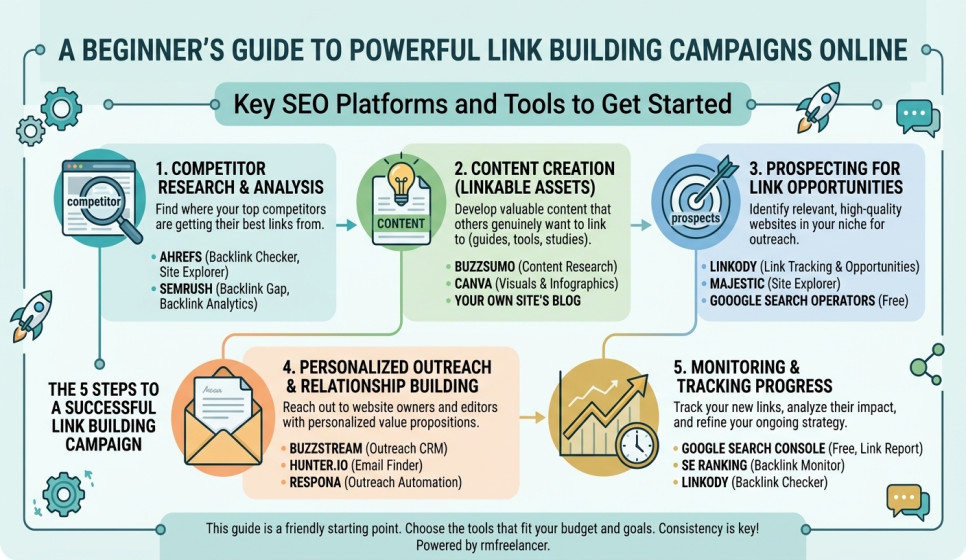
A simple workflow may encompass goal setting, competitor research, prospect evaluation, content creation, outreach, follow-up, monitoring, and reporting. Employ an SEO platform for research and a project-management tool to track deadlines and responsibilities.
Set achievable targets based on quality and carefully assess campaign results each month.
Frequently Asked Questions (FAQs)
What constitutes a link-building SEO platform?
ANSWER:
A link-building SEO platform is a tool designed to assist users in discovering backlink opportunities, analyzing competitors, finding pertinent websites, monitoring outreach efforts, and tracking the effectiveness of acquired links.
How can SEO platforms benefit beginners in link building?
ANSWER:
Beginners can leverage these platforms to pinpoint relevant websites, research competitors’ backlinks, assess the quality of domains, organize outreach initiatives, and keep track of newly gained or lost backlinks.
What features are essential for beginners when selecting a link-building platform?
ANSWER:
Key features to look for include backlink analysis, competitor research, prospect discovery, domain metrics, outreach management, contact organization, campaign tracking, and performance reporting.
In what way does competitor backlink analysis facilitate link building?
ANSWER:
Competitor analysis reveals which websites are linking to rival businesses. These sites can provide valuable insights for directories, guest posts, collaborations, interviews, or other relevant outreach avenues.
What criteria determine the value of a backlink opportunity?
ANSWER:
A valuable backlink opportunity is typically relevant to your field, trusted by users, earned editorially, and placed on a website that has authentic content and an engaged audience.
Can SEO platforms ensure successful backlinks?
ANSWER:
No. While SEO platforms can identify prospects and aid in managing campaigns, they cannot guarantee that website owners will respond positively or publish a link.
Should beginners prioritize the quantity or quality of backlinks?
ANSWER:
Beginners should concentrate on quality and relevance rather than quantity. A smaller number of credible, industry-related backlinks is usually more advantageous than numerous irrelevant or low-quality links.
How do outreach features aid in managing link-building campaigns?
ANSWER:
Outreach features can help organize prospects, track contact information, schedule follow-ups, document conversations, monitor responses, and indicate which opportunities are still open.
How can beginners steer clear of risky link-building opportunities?
ANSWER:
Avoid platforms or providers that advocate for bulk links, private blog networks, irrelevant websites, hidden links, automated spam, or guaranteed rankings. It's essential to evaluate each website's relevance, content quality, and authenticity before reaching out.
What metrics should beginners use to evaluate the success of a link-building campaign?
ANSWER:
Monitor key metrics such as the number of relevant referring domains, link quality, referral traffic, rankings for targeted keywords, organic traffic, conversions, and the number of links gained or lost over a period. Focus on substantial business outcomes instead of just the count of backlinks.
Looking Ahead,
SEO platforms empower newcomers to plan link-building campaigns with greater structure and confidence. They expose competitor patterns, content opportunities, prospect insights, broken links, and campaign developments. Their data becomes invaluable when complemented with careful evaluation, useful content, respectful communication, and ethical discretion.
Select a platform that aligns with your objectives, study pertinent opportunities, and prioritize websites that cater to genuine audiences. Avoid shortcuts and focus on metrics beyond just link counts. With consistent research and authentic value, novices can construct a sustainable link-building process that enhances visibility, fosters trust, and promotes long-term business growth.
If you have any questions or concerns, please contact our friendly support team for immediate assistance.
Website: https://rmfreelancer.com/
Email: support@rmfreelancer.com
Phone: +1 307-243-8976
RMFreelancer Office:
30 N Gould St, Ste R, Sheridan, WY 82801, USA


