27
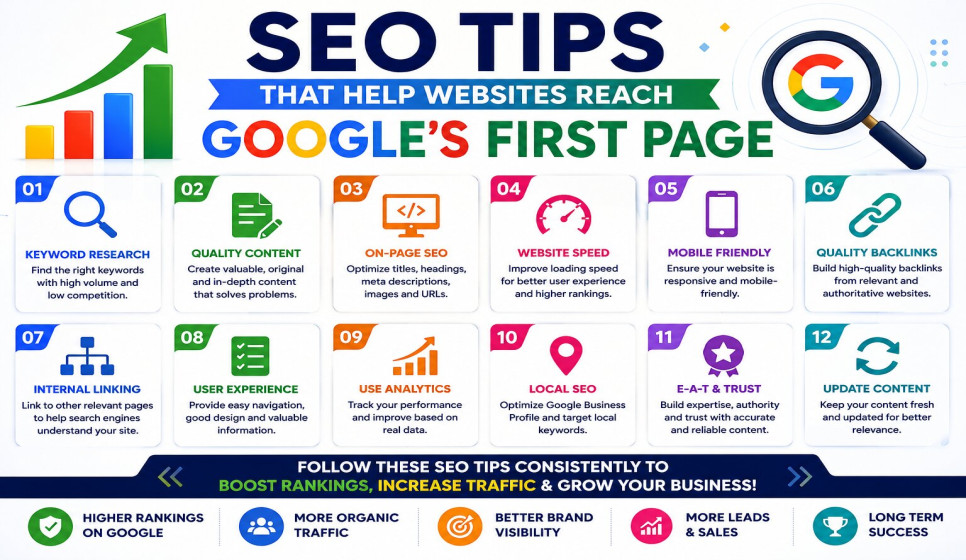
JulSEO Tips That Help Websites Reach Google's First Page
Ranking on the first page of Google is often considered one of the most important achievements for website owners, bloggers, business owners, and online marketers. When a website appears on the top results of Google, it benefits from a significant increase in organic traffic, which means more people are visiting the site naturally without needing to pay for ads. This visibility also helps build trust and credibility for the brand, making it more likely that visitors will engage with the content or take action, such as signing up for a newsletter, making a purchase, or contacting the business.
Although there is no guaranteed, quick way to guarantee a top spot on Google’s first page, following well-established SEO best practices can greatly enhance a website's chances of being seen by more users over time.
This guide provides useful, real-world SEO advice that can help your website not only compete effectively for high rankings on the first page of Google but also establish itself as an authoritative and reliable source of information in your niche.
Every effective SEO strategy starts with a thorough keyword research process. The aim here is to figure out what your audience is actually looking for and then build content that truly meets their needs.
When choosing keywords, you should look for ones that:
Match the products or services you provide
Have a decent number of searches
Are relevant to the interests and needs of your audience
Are competitive enough that you can stand a chance against others in the same space
Long-tail keywords are especially useful since they target people who have very specific needs or questions. Instead of going after broad terms like "SEO," think about more specific phrases such as "best SEO tips for small businesses" or "how to improve Google rankings naturally."
Creating content that's helpful and original is key to succeeding in SEO.
Google values content that genuinely adds value to its users. So, instead of writing just for the search engines, focus on crafting articles that answer questions in a clear and thorough way.
High-quality content should be:
Unique and not copied from anywhere
Cover the subject in detail
Include real-life examples or scenarios
Be easy to understand for all readers
Keep up to date with the latest information
Offer real solutions that people can use
By consistently publishing valuable content, you can encourage others to share your work, earn backlinks, and build a loyal audience who keeps coming back for more.
Optimizing your page titles is one of the most important steps in on-page SEO.
A good SEO title should include the main keyword you're targeting.
It should also be clear and give a good idea of what the page is about. Keep it around 50-60 characters long so it displays fully in search results. Make sure it's enticing enough to make people click on your link.
Here’s an example of a strong title:
"SEO Tips That Help Websites Reach Google's First Page"
Avoid cramming too many keywords into the title.
Using natural, conversational language is better for both users and search engines.
Meta descriptions, although they don’t directly influence rankings, play a big role in how users decide whether to click on your link.
A strong meta description should:
Give a quick summary of what the page is about
Naturally include the main keyword
Encourage users to visit your page
Be around 150-160 characters long
Higher click-through rates can lead to better overall search performance, which in turn can help boost your visibility in search results.
Using proper heading structure is an essential part of organizing your content for both readers and search engines.
Here’s how you should use headings:
Use H1 for the main title of the page
Use H2 for major sections within the content
Use H3 for sub-sections or supporting topics
Headings not only make your content easier to read, but they also help search engines understand the overall structure and context of your pages.
Website loading speed is a major factor in SEO and greatly impacts user experience.
To improve the speed of your site, you can take the following steps:
Compress images to reduce their file size
Minify CSS and JavaScript code to reduce file sizes
Remove unnecessary plugins and scripts
Enable browser caching to speed up load times
Choose a reliable and fast web hosting provider
Reduce server response time by optimizing your hosting plan and server settings
Users are more likely to stay on your website and engage with your content if it loads quickly. This can also lead to lower bounce rates and better user engagement.
Making your website mobile-friendly is another crucial element of SEO.
With Google using mobile-first indexing, the mobile version of your site is the primary one it evaluates for rankings.
Ensure your site meets these requirements:
Uses responsive design that adjusts to different screen sizes
Has large enough text for easy reading on smartphones
Features a mobile-friendly menu and navigation system
Loads quickly on mobile devices
Provides a smooth browsing experience, especially for touchscreen users
A mobile-friendly website not only benefits users but also helps search engines rank your site higher.
Backlinks are among the most important ranking factors Google uses to determine a website's authority and relevance.
To build high-quality backlinks, focus on ethical methods like:
Writing guest posts for reputable websites in your industry
Publishing original research or in-depth guides that others might want to link to
Creating shareable content that others are inclined to recommend or link to
Building relationships with other professionals or bloggers in your niche
Offering helpful tutorials or step-by-step guides that solve real problems
Avoid shady tactics like buying links or using link farms, as these can harm your site's reputation and lead to penalties from Google.
Internal linking is a key component of SEO that can improve both user navigation and search engine visibility.
Internal links do the following:
Help search engines better crawl and index your content
Distribute page authority across your site
Make it easier for users to find related content
Increase the time users spend on your website
When you publish new content, link it to related pages using clear, descriptive anchor text.
This helps both your audience and search engines understand the context and relevance of your content.
Images can enhance user engagement, but they must also be optimized for SEO.
Here are the best practices for optimizing images:
Compress image files to reduce their size without losing quality
Use descriptive filenames that include relevant keywords
Add meaningful alt text that describes the image's content
Choose modern image formats like WebP or JPEG 2000 when appropriate
Avoid using unnecessarily large image dimensions
Optimizing images improves page speed and makes your content more accessible to people with disabilities.
Technical SEO refers to the behind-the-scenes elements that help search engines crawl and index your website effectively.
Focus on the following technical aspects:
Creating and submitting XML sitemaps
Implementing HTTPS security to protect user data
Using clean and structured URLs
Adding canonical tags to avoid duplicate content issues
Using structured data (Schema markup) to provide more context to search engines
Fixing broken links
Removing or managing duplicate content
Regular technical audits can help identify issues before they impact your site’s rankings or performance.
Google prioritizes content that best matches the user's search intent.
Search intent refers to the underlying purpose or goal behind a search query.
Common types of search intent include:
Informational (users are looking for information or explanations)
Navigational (users are looking for a specific website or page)
Commercial (users are researching products or services before making a purchase)
Transactional (users are looking to complete a purchase or take an action)
Before you create content, ask yourself what users are hoping to find when they search for your target keyword.
Tailor your content to match those expectations to ensure it meets their needs.
User experience (UX) is becoming an increasingly important factor in SEO.
A positive user experience can lead to higher engagement, longer time spent on your site, and better rankings.
A well-designed website should:
Be easy to navigate with a clear structure
Have intuitive menus and search functionality
Use readable fonts and good contrast for easy reading
Avoid intrusive pop-ups or distractions that might frustrate users
Be responsive and work well on all devices
Make it easy for users to find important information quickly
A website that satisfies users is more likely to keep them coming back for more.
Publishing fresh content regularly is essential for maintaining relevance and visibility in search results.
Consider publishing the following types of content:
Blog articles
Tutorials
Industry news updates
Case studies
Product guides
Frequently asked questions
Resource pages
Regular updates signal that your website is active and continues to provide valuable information, which can help you stay competitive in your niche.
Monitoring your site's performance is key to understanding what’s working and what needs improvement.
Track important metrics such as:
Organic traffic
Keyword rankings
Click-through rate (CTR) from search results
Bounce rate
Average session duration
Indexed pages
Core Web Vitals
Using this data, you can refine your SEO strategy over time and make more informed decisions.
If your business serves a specific local area, local SEO can help you reach nearby customers more effectively.
Key local SEO practices include:
Creating and maintaining a Google Business Profile
Using location-based keywords in your content
Collecting genuine customer reviews to build trust
Keeping business information consistent across directories
Building local citations from reputable local directories
These efforts can improve your visibility in local search results and on maps, helping you connect with customers in your area.
Demonstrating experience, expertise, authority, and trust (E-E-A-T) can significantly improve your website's credibility in the eyes of both users and search engines.
You can strengthen these signals by:
Publishing accurate and reliable information
Citing trusted sources when necessary
Keeping your content up to date with the latest developments
Providing clear information about your author or business
Maintaining an About page and including clear contact details
Being transparent and honest about your business and its values
When users perceive your website as trustworthy, they’re more likely to visit, engage, and return in the future.
Making avoidable SEO mistakes is a common pitfall for many websites and can hinder your progress.
Some of the most common mistakes include:
Keyword stuffing, which involves overusing keywords in an unnatural way
Duplicate content that can confuse search engines and users alike
Slow-loading pages that frustrate users and hurt rankings
Broken links that lead to errors and a poor user experience
Poor mobile usability that makes it difficult for users to access your site on phones
Thin or low-value content that doesn't provide
Conclusion,
Getting your website to appear on the first page of Google involves a mix of high-quality content, smart keyword research, technical improvements, a great user experience, and ethical link building. Instead of looking for quick fixes, focus on building a website that truly helps people and is easy for search engines to understand.
Search engine optimization is something you have to keep working on, not something you do once and forget. By regularly applying these effective SEO strategies, keeping track of how your site is performing, and staying up to date with changes in search algorithms, you can boost your website's visibility, bring in more organic traffic, and improve your chances of landing on Google's first page. With time and consistent effort, these actions can help build stronger authority, encourage better user engagement, and lead to long-term online success.
Have questions about our services? Contact us today for fast, reliable, and professional customer support always.
Website: https://rmfreelancer.com/
Email: support@rmfreelancer.com
Phone: +1 307-243-8976
RMFreelancer Office:
30 N Gould St, Ste R, Sheridan, WY 82801, USA


