27
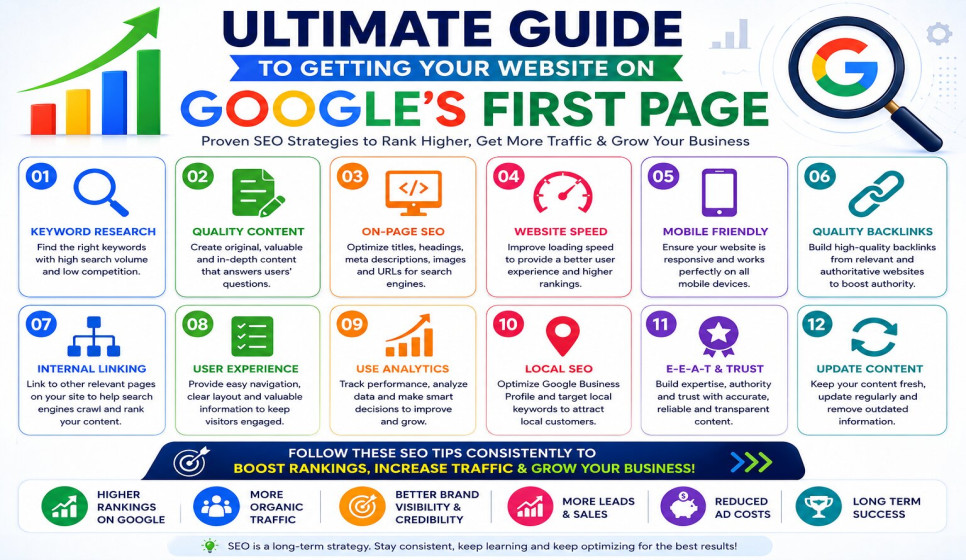
JulUltimate Guide to Getting Your Website on Google's First Page
Getting your website to appear on Google's first page of search results is a common goal for bloggers, entrepreneurs, eCommerce stores, and businesses of all sizes. When a website ranks higher in search results, it gains more visibility, which leads to more organic traffic, better chances of attracting qualified leads, and builds stronger brand authority. However, achieving a top position on Google's first page is not something that can be done quickly. It requires a steady effort, combining quality content, technical optimization, a user-friendly website design, and continuous SEO practices.
This comprehensive guide outlines tested and effective strategies that can help boost your website's visibility in Google Search while ensuring you follow the best practices of SEO.
Why Ranking on Google's First Page?
Google processes billions of search queries every single day, and most users typically click on the results that appear on the first page of search results.
Websites that rank higher generally get more clicks compared to those that show up later in the search results.
There are several benefits to securing a spot on the first page of Google:
Increased organic traffic: More people will find your website through search results.
Higher brand credibility: Ranking on the first page can make your brand appear more trustworthy.
Better lead generation: More visitors can lead to more potential customers and sales.
More online sales: Increased traffic often translates into more conversions.
Improved user trust: Users tend to trust websites that appear on the first page.
Long-term marketing value: A strong search presence can provide ongoing benefits over time.
Lower dependence on paid advertising: A high search ranking can reduce the need for expensive pay-per-click ads.
While every industry is unique, consistent and effective SEO strategies can significantly improve your chances of gaining valuable search visibility.
1.
Understand How Google Ranks Websites
Google uses hundreds of ranking signals to decide which pages best answer a user's search query.
While the exact algorithm is not fully known, there are several well-documented ranking factors that can influence your website's position:
Content quality: Google favors content that provides valuable and relevant information.
Search intent: The purpose behind a user's search query plays a key role in relevance.
Website speed: A faster website offers a better user experience.
Mobile usability: Google prioritizes websites that work well on mobile devices.
Backlink quality: High-quality links from other reputable websites can boost your site’s authority.
User experience: A website that is easy to navigate and engaging is more likely to rank well.
Technical SEO: This includes elements like site speed, URL structure, and proper use of metadata.
Internal linking: Connecting relevant pages within your own website can improve navigation and user engagement.
Page relevance: Your content needs to be closely related to what users are searching for.
Website authority: Search engines favor websites that are trusted and regularly updated.
Rather than trying to trick the search engine algorithm, focus on building a website that provides real value to your visitors.
2.
Perform Thorough Keyword Research
Keyword research is the foundation of any successful SEO campaign.
When conducting keyword research, look for keywords that:
Match your niche: Choose keywords that are relevant to the topics your website covers.
Have consistent search demand: Ensure that the keywords are frequently searched by users.
Are relevant to your audience: Focus on terms that your target audience is likely to use.
Have realistic competition: Avoid keywords that are too popular or difficult to rank for.
Reflect user intent: Understand what users are looking for when they type in a search query.
Instead of focusing only on broad keywords, include long-tail keywords as well.
Examples of long-tail keywords include:
Long-tail keywords tend to attract visitors who are looking for specific information, making them highly valuable for targeted traffic.
Google wants to show search results that match what users are really looking for. So, it's important to understand the purpose behind each search.
There are four main types of search intent that users have:
1.
Informational: Users are trying to learn something new.
*Example:* "How to improve website SEO"
2.
Navigational: Users want to go to a specific website.
*Example:* "Google Search Console"
3.
Commercial: Users are researching products or services before making a decision.
*Example:* "Best SEO tools"
4.
Transactional: Users are ready to make a purchase.
*Example:* "Buy SEO services"
When creating content, it's better to focus on matching the intent of the search rather than just including keywords. This helps search engines and users find exactly what they need.
Content is one of the most important factors Google considers for ranking.
Your content should:
Answer questions readers have
Be accurate and reliable
Offer unique perspectives and insights
Include practical examples that people can apply
Stay updated with the latest trends and information
Be easy to understand for all users
Avoid these common mistakes:
Duplicate content that appears on multiple pages
Thin articles that don’t offer enough value
Overusing keywords in an unnatural way
Using AI-generated content without human review
Using misleading headlines that don’t reflect the content
When you create content that truly helps people, it builds trust with both your audience and search engines.
Every page you create should be optimized for SEO.
Here’s how you can do that:
SEO Title: Include your main keyword in a natural way.
Example: Ultimate Guide to Getting Your Website on Google's First Page
Meta Description: Write a short summary that encourages people to click.
*Example:* "Learn how to boost your website rankings and appear on Google's first page with this ultimate guide."
URL Structure: Keep your URLs short, descriptive, and include keywords.
*Example:* "example.com/google-first-page-guide"
Headings: Use headings (H1, H2, H3) to organize your content, making it easier for readers and search engines to follow.
Website speed is another important factor that affects both user experience and search performance.
Ways to improve speed include:
Compressing images
Using modern image formats like WebP
Removing unnecessary plugins
Enabling browser caching
Minifying CSS and JavaScript files
Choosing a reliable hosting provider
Using a CDN (Content Delivery Network) when appropriate
A faster website keeps visitors engaged and reduces the chance of them leaving quickly.
Google mainly uses the mobile version of websites for indexing, so your site needs to be mobile-friendly.
This means:
Using responsive design that works on all screen sizes
Ensuring the text is easy to read on small screens
Making sure links and buttons are touch-friendly
Optimizing for fast loading times on mobile devices
A great mobile experience benefits both users and your site's rankings.
Regularly publishing new content shows search engines that your website is active and up-to-date.
Some great content ideas include:
Tutorials
Industry news
Case studies
FAQs
Product comparisons
Expert interviews
Beginner guides
Checklists
Consistency is key, and it's better to publish regularly than to post large amounts of content all at once.
Backlinks are links from other websites to yours.
They help search engines recognize your content as valuable, especially if the links come from reputable source's.
Some ethical ways to build backlinks include:
Guest posting on trusted websites
Creating valuable, shareable resources
Publishing original research
Digital PR efforts
Partnering with industry experts
Outreach for resource pages
Broken link building
Avoid link schemes and other spammed practices because they can hurt your site’s reputation.
Internal links connect different pages on your website.
Benefits of internal linking include:
Helping search engines find and crawl your content better
Improving user navigation
Distributing page authority across your site
Increasing time users spend on your site
Helping users discover more content
When linking, use descriptive anchor text and make sure the links are relevant.
Image SEO is often overlooked, but it plays an important role.
Best practices for image SEO include:
Compressing images to reduce file size
Using descriptive filenames
Adding meaningful alt text to describe the image
Choosing appropriate dimensions
Avoiding unnecessarily large file sizes
Optimized images help your site load faster and improve accessibility for all users.
Technical SEO ensures your website is easy for search engines to find and understand.
Important areas include:
XML Sitemap: Submit your sitemap through Google Search Console.
HTTPS: Secure your website with SSL encryption.
Robots.txt: Allow search engines to access important pages on your site.
Canonical Tags: Prevent duplicate content issues by specifying the preferred version of a page.
Structured Data: Use schema markup where appropriate to help search engines understand your content and display it better in search results.
Providing a good user experience is crucial for SEO.
Ways to improve user experience include:
Using simple and intuitive navigation
Making pages easy to read and follow
Avoiding intrusive pop-ups that interfere with content
Keeping layouts clean and uncluttered
Using enough white space to separate content areas
Including clear calls to action (CTAs) to guide users
When users have a positive experience, they are more likely to stay longer, explore other pages, and return to your site.
Google values content that shows Experience, Expertise, Authoritativeness, and Trustworthiness (E-E-A-T).
To strengthen these signals, consider:
Publishing accurate and up-to-date information
Showing firsthand experience with the topic
Updating old content to ensure it's current
Including author information to establish credibility
Providing clear contact details
Being transparent with your policies and practices
Building trust takes time, but it leads to long-term SEO success.
Google Search Console is a powerful and free SEO tool that helps you monitor your website’s performance.
Using it can help you track:
Search impressions
Clicks
Average ranking position
Indexed pages
Crawl errors
Core Web Vitals
Mobile usability
Reviewing the data regularly can help you identify opportunities and fix problems before they affect your rankings.
Tracking your performance is essential for refining your SEO strategy.
Important metrics to monitor include:
Organic traffic
User engagement
Conversion rate
Bounce rate
Returning visitors
Top-performing pages
Traffic sources
Use these insights to improve pages that aren't performing well and expand on content that’s working.
SEO isn’t only about creating new pages.
Updating existing content can also be beneficially.
By revising old articles, you can:
Improve accuracy
Add new and relevant information
Increase the content’s relevance to current trends
Target additional keywords
Enhance user engagement
Freshening up old content can help maintain or even improve your site’s rankings over time.
Many websites struggle with the same mistakes because they repeat them without correction.
Common SEO mistakes include:
Keyword stuffing in an unnatural way
Duplicate content appearing on multiple pages
Slow-loading websites that frustrate users
Broken links that lead to dead ends
Poor internal linking that doesn’t guide users effectively
Ignoring mobile users who access your site on phones
Getting low-quality backlinks from unreliable sources
Publishing thin content that doesn’t provide real value
Failing to keep your content and website up-to-date
Neglecting technical SEO aspects that affect your site’s performance
Regular SEO audits can help you find and fix these issues before they negatively impact your search rankings.
Instead of publishing isolated articles, consider creating a collection of related content around a central topic.
For example, if your website is focused on SEO, you can create articles about:
Keyword research
On-page SEO
Technical SEO
Link building
Local SEO
Content marketing
SEO tools
Website optimization
By interlinking these articles, you help both users and search engines better understand your expertise in the subject.
SEO is not something you can complete in a day.
It’s a long-term strategy that requires patience and consistency. Depending on your niche, competition, and the current state of your website, meaningful improvements can take several months. Focus on making small, steady improvements rather than expecting quick results.
Consistency is the key to long-term success.
Keep improving your content, fixing technical issues, earning high-quality backlinks, and monitoring your site’s performance. Even small improvements made regularly can add up to significant results over time.
Closing thoughts,Getting your website to show up on the first page of Google needs a mix of good content, smart keyword choices, technical improvements, a great user experience, and honest link building.
There's no one-size-fits-all way to get to the top, but sites that keep providing useful information, answer people's questions, and follow SEO guidelines are more likely to improve their search results.
Keep in mind that SEO is something you have to keep working on.
Search trends, what people expect, and how Google's system works all change over time. That's why it's important to check your plan often and make changes when needed. By creating helpful content, keeping your site fast and mobile-friendly, building a reliable online image, and tracking your progress, you can slowly but surely increase your chances of appearing on Google's first page and bringing in steady organic traffic for years.
If you have any questions or concerns, please contact us:
Website: https://rmfreelancer.com/
Email: support@rmfreelancer.com
Phone: +1 307-243-8976
RMFreelancer Office:
30 N Gould St, Ste R, Sheridan, WY 82801, USA


